
STANAG 6001 Level 3 – Speaking Task (Discussion): Factors Influencing the Success of Peacekeeping Operations
Examination Task
Peacekeeping operations often face complex challenges in unstable regions. Look at the list below and decide which factor has the greatest and which has the least influence on the success of a mission. Be ready to justify your choice.
- Cooperation with local authorities
- Clarity of the mission mandate
- Availability of logistical support
Sample Discussion
A: There are several important factors that can influence the success of peacekeeping operations. Let’s discuss cooperation with local authorities, clarity of the mission mandate, and the availability of logistical support, and decide which has the greatest and which has the least influence on the success of a mission. Do you agree?
B: Yes. In my opinion, one of the most important factors is cooperation with local authorities, because local institutions, police forces, and community leaders have the best understanding of the realities, threats, and cultural conditions of a given region. Without effective coordination with local authorities, peacekeeping forces may find it difficult to achieve full situational awareness and ensure freedom of movement. A lack of cooperation may lead to tensions, limited access to information, and difficulties in carrying out operational tasks. On the other hand, such cooperation helps build trust and increases operational effectiveness. What do you think?
A: I agree that cooperation with local authorities is very important and increases the legitimacy of international forces’ actions. If an operation is perceived as being supported by local authorities, it is easier to gain the trust of the civilian population and reduce social tensions. This is particularly important in unstable environments, where a lack of trust may lead to an escalation of conflict. Such cooperation also contributes to building long-term stability, as the aim of peacekeeping missions is not only to ensure short-term security, but also to strengthen local structures.
B: That’s true. It is also worth noting that cooperation with local authorities helps to understand local customs, beliefs, culture, and the religion practiced by a given community. All of this makes it possible to understand the behaviour of the other side and creates an opportunity to be accepted and understood. Intercultural awareness allows for better integration with the local community.
A: I agree; however, I believe that an even more important factor is the clarity of the mission mandate. A precisely defined mandate, including clearly established rules of engagement, ensures a consistent interpretation of tasks and enables commanders to make quick and appropriate decisions. On the other hand, an unclear mandate may lead to differences in the interpretation of operational objectives and limit the effectiveness of response in crises. Do you share this opinion?
B: Yes, that is a very valid point. The clarity of the mandate is crucial because it forms the foundation of all operational and decision-making processes. It defines the mission’s objectives, the scope of authority, and the rules of engagement, thus establishing the framework within which commanders and soldiers operate. Without it, even well-prepared units may act in an uncoordinated manner.
A: In addition, a clear mandate strengthens the credibility and legitimacy of the mission both internationally and in the eyes of the local population. It shows that actions are conducted in accordance with defined principles and international law. Let’s now move on to the third factor, which is the availability of logistical support. What do you think about its importance?
B: The availability of logistical support has a direct impact on the operational capability of the forces. Even the best-planned operation cannot be carried out effectively without proper supplies, transport assets, communication systems, and medical support. Logistics ensures continuity of operations and enables units to maintain readiness. For example, an adequate number of vehicles and air transport assets allows for the rapid movement of forces, patrolling of the area of operations, and response to crises. Shortages in this area may lead to reduced mobility and response capability. However, I believe that logistics, although very important, has a slightly smaller impact than the other two factors.
A: I understand your point of view and I agree that logistics is essential for maintaining operational capability. It can also be adjusted to some extent during the course of the operation, whereas changing the mandate or building effective cooperation with local authorities is much more complex and time-consuming.
B: That’s true. Political and legal factors are generally more difficult to modify than logistical issues. Therefore, we can conclude that the clarity of the mandate has the greatest influence on the success of the operation, while the availability of logistical support, although still important, has the least influence among the factors discussed.
A: Exactly. To sum up, a clear mandate ensures coherence and effectiveness of actions, cooperation with local authorities enables effective functioning in the operational environment, and logistics supports the execution of tasks, although its importance is slightly lower compared to the other elements.
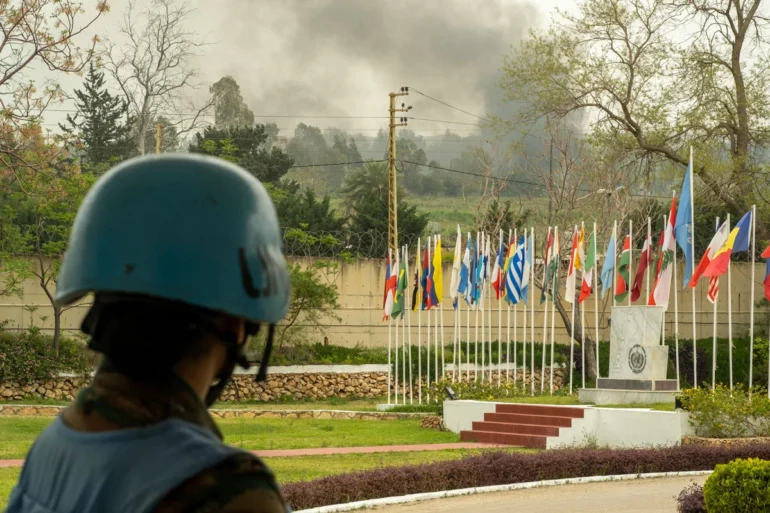
Photo: Dust and smoke after IDF demolition in Naqoura, southern Lebanon, 2 April 2026, Kandice Ardiel (UN)