
STANAG 6001 Level 3 – Writing Task (Report): Reconnaissance Aircraft Deployment in the Persian Gulf
Examination Task
Write a minimum of 200 words on the topic below.
Recent reports indicate a growing need for the deployment of advanced airborne reconnaissance aircraft in the Persian Gulf. This region is of high strategic importance due to energy transport and rising tensions with Iran. Write a report in which you:
- describe the current situation and the threats posed by Iranian drones, cruise missiles, and maritime disruption;
- assess the impact on military operations and regional security;
- suggest measures to improve surveillance and response capabilities;
- consider possible future developments if the conflict continues or escalates.
Sample Answer
Subject: Reconnaissance Aircraft Deployment in the Persian Gulf
Introduction
The aim of this report is to analyse the deployment of advanced airborne reconnaissance aircraft in the Persian Gulf. The region is strategically important for global energy supplies and regional security. Recent reports indicate that the United States is deploying such aircraft to strengthen surveillance and response capabilities against low-flying aerial threats from Iran. This report examines the current situation, the potential impact on regional security and military operations, measures to improve surveillance, and possible future developments.
Current Situation and Threat Assessment
Regional tensions with Iran continue to rise, creating a more complex security environment in the Persian Gulf. Aerial and maritime threats are becoming increasingly sophisticated, particularly low-flying drones and sea-skimming cruise missiles. These systems are designed to avoid conventional radar and can be hard to detect in busy areas like the Strait of Hormuz.
The current phase of the conflict has exposed a specific vulnerability: detecting fast-moving, low-altitude targets. Iranian attacks have expanded beyond isolated strikes to a multi-domain contest, affecting both civilian and military installations, including oil and gas facilities and airports in the Gulf states and commercial shipping routes. This evolution increases the risk of disruption to regional security, naval operations, and the safe passage of energy supplies.
Overall, the situation indicates that existing surveillance capabilities alone are insufficient to provide continuous early warning of low-altitude threats. Persistent monitoring and improved detection are necessary to address this gap and to reduce the operational risk posed by rapidly evolving aerial and maritime threats in the region.
Impact and Measures
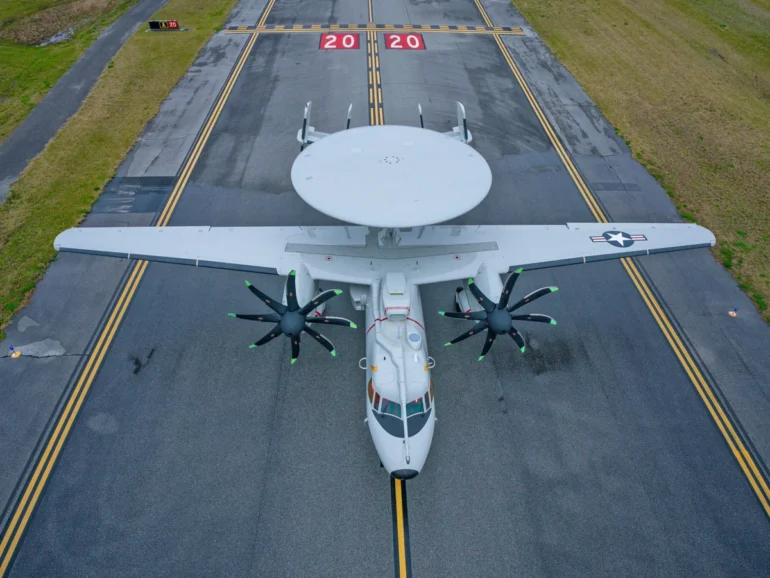
The deployment of reconnaissance aircraft, such as the E‑2D Hawkeye, enhances situational awareness, defensive coordination, and strike support. Advanced radar and networked systems allow information to be shared across air, sea, and ground platforms, giving forces additional time to respond to Iranian threats. Maintaining a continuous, high-resolution picture of the region is now essential for both offensive operations and the protection of shipping lanes and allied assets. Persistent airborne surveillance reduces operational risk and strengthens regional security. Additional measures could include integrating unmanned systems, expanding sensor coverage, and maintaining continuous intelligence sharing among allied forces.
Possible Future Developments
If regional tensions continue to escalate, sustained airborne surveillance may be required for an extended period. Continuous monitoring could deter hostile actions and help mitigate the effects of Iranian drones and missiles. Long-term presence of reconnaissance aircraft will support deterrence, early warning, and coordinated defence across the multi-domain battlespace. Adaptation of detection technologies and cooperation among allied forces will be essential to address evolving threats and maintain regional stability.
Conclusion
Advanced reconnaissance aircraft are critical for monitoring low-flying drones, missiles, and small maritime threats in the Persian Gulf. Their deployment strengthens early warning capabilities, supports coordinated defence operations, and contributes to regional stability. Continuous surveillance and collaborative measures are necessary to manage evolving threats and maintain security in this strategic region.
Photo: E-2D Advanced Hawkeye © Northrop Grumman