
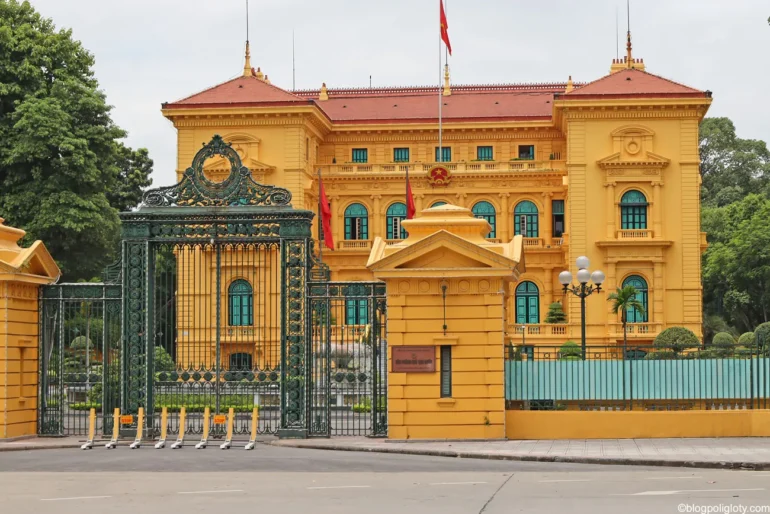
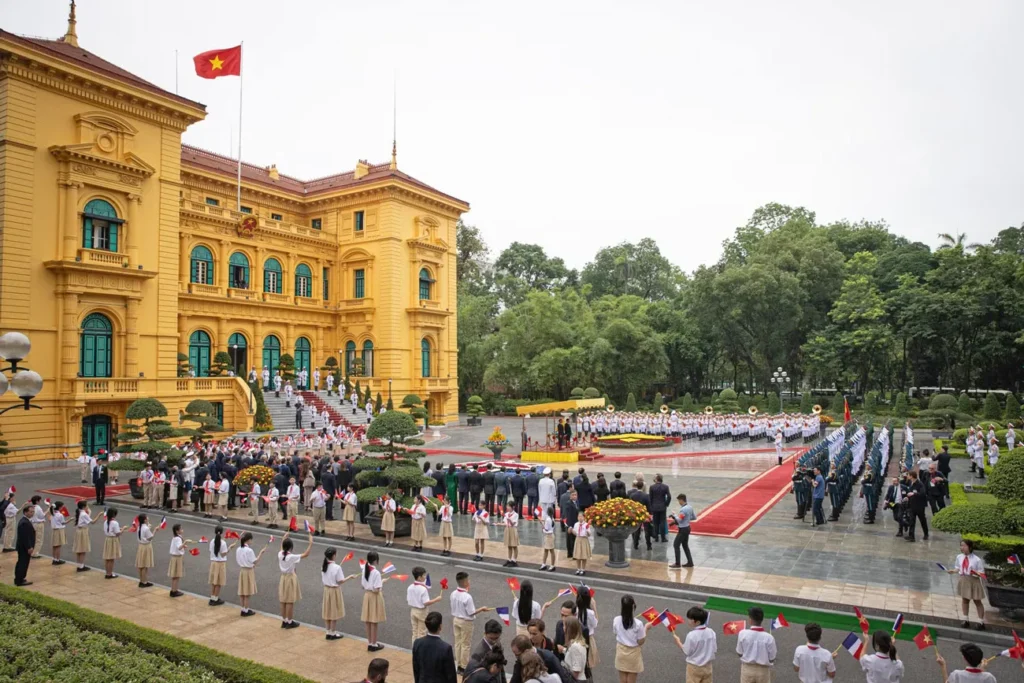
Right in the heart of Hanoi, just north of the Ho Chi Minh Mausoleum, stands the impressive Presidential Palace (Phủ Chủ tịch). With its bright yellow façade, tall windows, and stately architecture, it is one of the most striking buildings in the Ho Chi Minh Memorial Complex. Surrounded by an extensive park with old trees, tropical plants, and a carp pond, it offers a place where Vietnam’s history can be experienced in a particularly distinctive way.
The first impression is surprising: behind wrought-iron gates flanked by small guardhouses stands a magnificent building whose appearance is more reminiscent of a European palace than a government building in Southeast Asia. At the same time, the lush vegetation and tropical trees lend the grounds their unmistakably Vietnamese character.
A Palace from the French Colonial Era
The Presidential Palace in Hanoi was built between 1900 and 1906 to serve as the residence of the French Governor-General of Indochina. At the time, Hanoi was an important administrative centre of French colonial rule. The imposing building was intended to visibly convey the power, wealth, and political ambitions of the colonial administration.
Sources differ in their attribution of the building’s design: while some name Charles Lichtenfelder as the architect, others credit Auguste-Henri Vildieu, the official French architect for Indochina. Regardless of this discrepancy, the building’s European character is unmistakable.
The palace has more than 30 individually designed rooms and a usable floor area of approximately 1,300 square metres. During the French colonial period, it was known as the Palais du Gouverneur général de l’Indochine française. From its completion until the victory of the August Revolution in 1945, a total of 29 governors-general and acting governors-general lived and worked there.
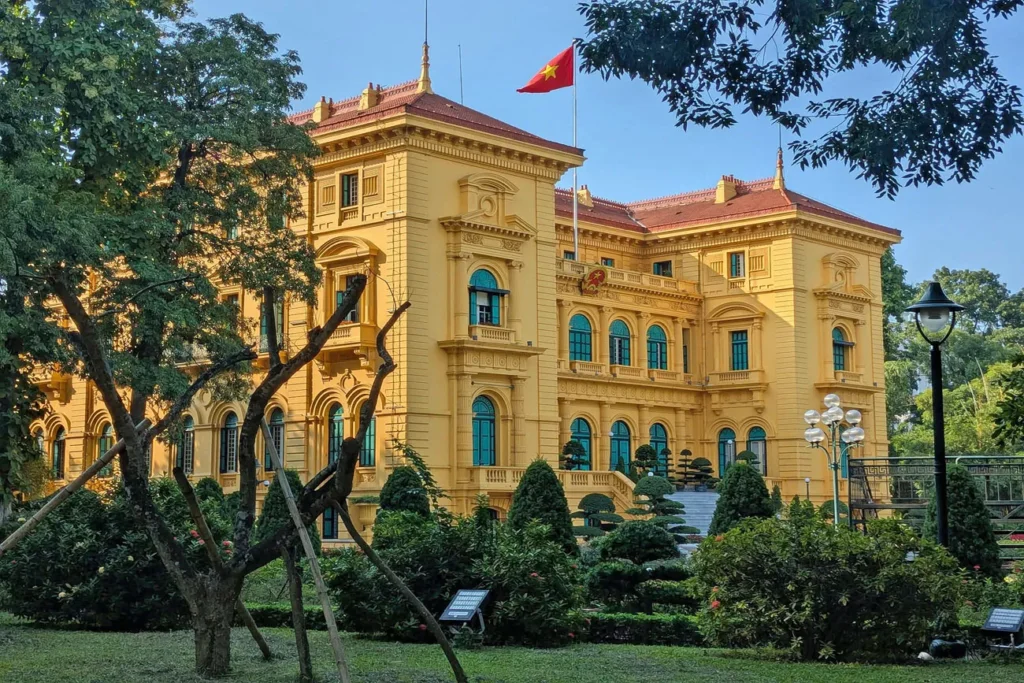
The building’s architecture combines neoclassical elements with features of the Italian Renaissance. Particularly striking are the symmetrical façade, tall windows, classical columns, and grand staircase leading to the main floor. The elaborately designed gables and emphasised corners of the building also contribute to its monumental appearance.
The yellow façade creates an appealing contrast with the park’s lush greenery. Viewed from the outside, the palace could almost make visitors forget that they are in Vietnam. Only the mango trees and tropical vegetation surrounding it serve as reminders that this European-influenced building stands in a completely different climatic and cultural environment.
From Colonial Palace to the Seat of Vietnamese Leadership
In August 1945, the August Revolution fundamentally transformed Vietnam’s political landscape. In 1945 and 1946, control of the building changed hands several times. Following Japan’s surrender, Chinese Nationalist troops initially took control of Hanoi. The French later returned and once again used the palace as an important centre of the French colonial administration.
On 2 September 1945, Ho Chi Minh proclaimed the independence of the Democratic Republic of Vietnam. France, however, refused to recognise Vietnamese independence, and the First Indochina War began in 1946. Following the French defeat at Điện Biên Phủ in 1954 and the Geneva Accords, Vietnam was temporarily divided along the 17th parallel into communist-ruled North Vietnam and Western-oriented South Vietnam. Tensions between North Vietnam and South Vietnam intensified over the following years, eventually leading to the Vietnam War, in which the United States deployed its own combat troops from 1965 onwards.
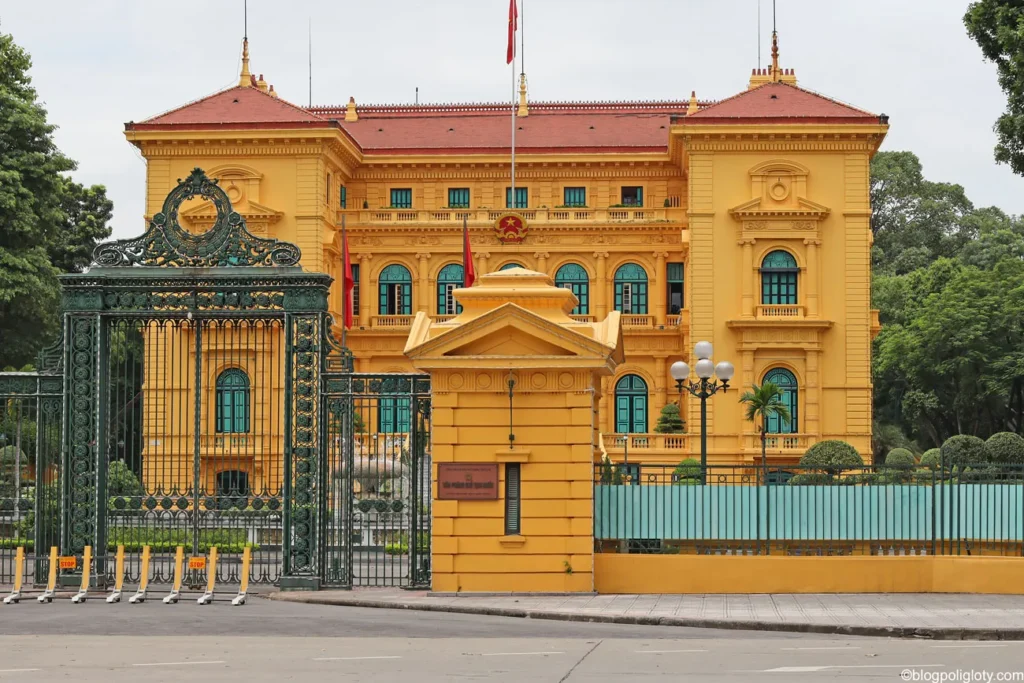
With the withdrawal of French troops from Hanoi in October 1954, a new chapter in the building’s history began. The former colonial palace became the Presidential Palace (Phủ Chủ tịch) and developed into an important centre of political leadership in North Vietnam.
Ho Chi Minh’s Choice of a Simple Life
Although the Presidential Palace was made available to Vietnam’s new leader, Ho Chi Minh consciously chose not to move into the magnificent building. Instead of living in the spacious rooms of the former colonial palace, he preferred modest accommodation on the same grounds. This decision was not merely practical but also symbolic: Ho Chi Minh wanted to distinguish himself from the lifestyle of the former colonial rulers and express his solidarity with the Vietnamese people.
Initially, Ho Chi Minh moved into a smaller building now known as House 54. He lived and worked there from December 1954 until mid-May 1958.
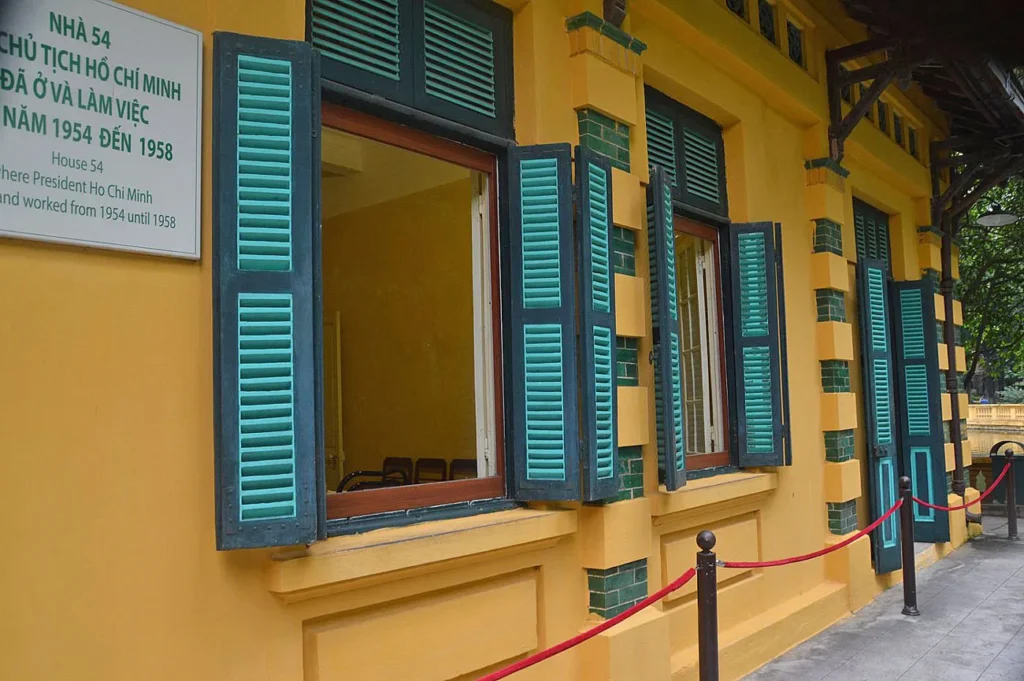
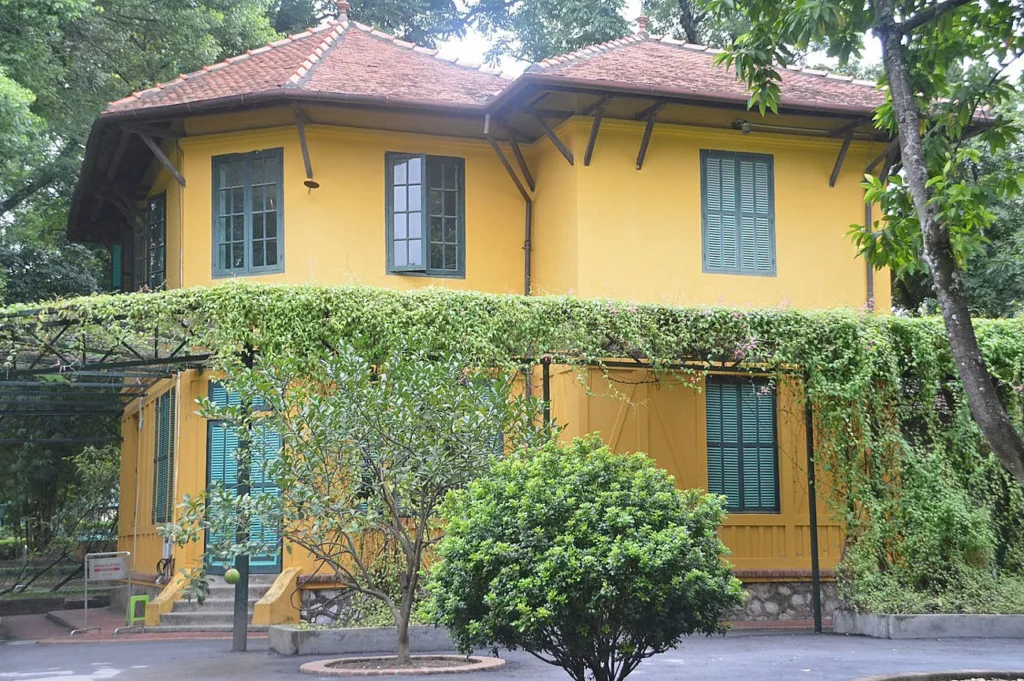
The house consists of three rooms arranged one behind the other. The room facing the pond served as both a study and a reception room. Behind it are the dining room and the bedroom. The furnishings are simple and functional. A plain bed, a table, chairs, and a wardrobe convey a sense of Ho Chi Minh’s modest lifestyle. Books, documents, personal belongings, and mementos received from international visitors have been preserved to this day, offering insights into his daily life.
Even after moving to the nearby stilt house, Ho Chi Minh continued to return regularly to House 54 for meals and medical check-ups, keeping the modest building an integral part of his daily life.
The Stilt House – A Modest Home Surrounded by Greenery
In 1958, Ho Chi Minh moved into a traditional Vietnamese stilt house built in the garden of the Presidential Palace in Hanoi. The simple wooden house with its tiled roof was designed according to Ho Chi Minh’s wishes and drew inspiration from the traditional architecture of the Tày and Thái ethnic groups in the Việt Bac region of northern Vietnam. Construction began on 15 April 1958, and the house was inaugurated on 17 May of the same year.
Even from the outside, the house looks quite different from the imposing Presidential Palace. Instead of a monumental façade, visitors see a simple wooden structure, a tiled roof, and a well-maintained garden filled with flowers and fragrant plants. A hibiscus hedge evokes the rural surroundings of Ho Chi Minh’s birthplace in Nghệ An Province.
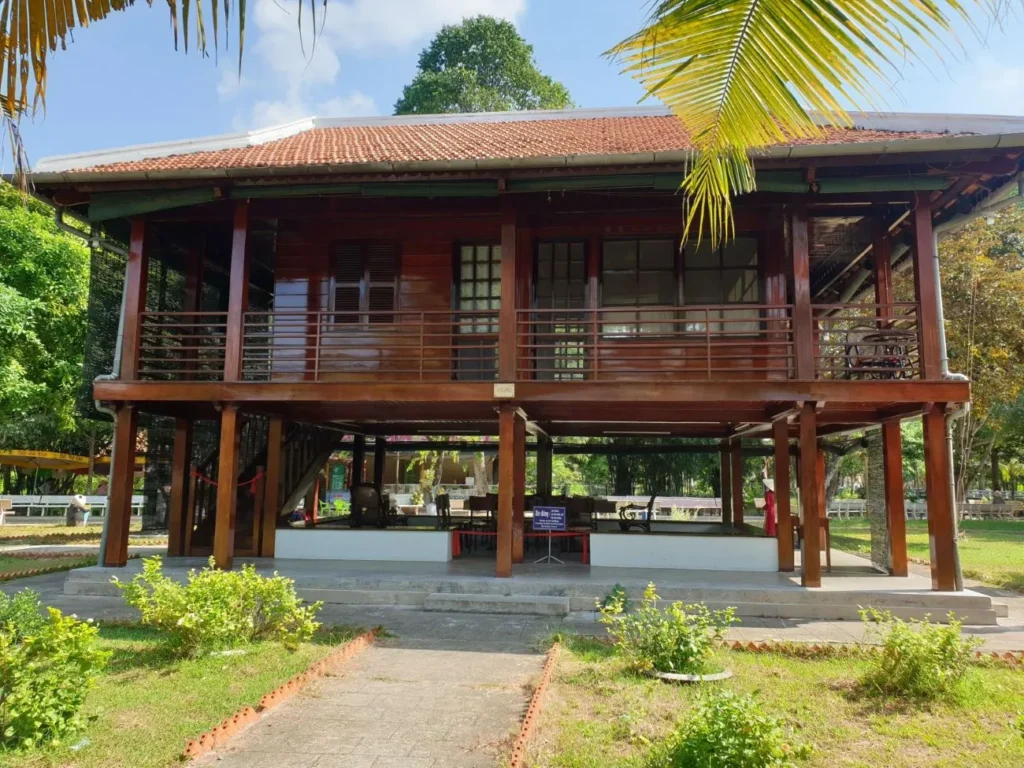
The house is arranged over two levels. The open ground floor, which is not enclosed by walls, served primarily as a workspace and reception area for Ho Chi Minh, especially during the summer months. Meetings with members of the Politburo, government representatives, and other guests took place here. A simple table and seating arrangement reinforces the modest character of the space.
The upper floor contains two rooms: a study and a bedroom. Both are simply furnished and reflect Ho Chi Minh’s unassuming lifestyle. A bookshelf separates the two areas. Books, newspapers, and other items have been preserved on the desk, offering a glimpse into his daily work.
Among the notable objects is a black stone pen holder shaped like a boat, presented to Ho Chi Minh in 1967 by Osvaldo Dorticós Torrado, the Cuban president at the time.
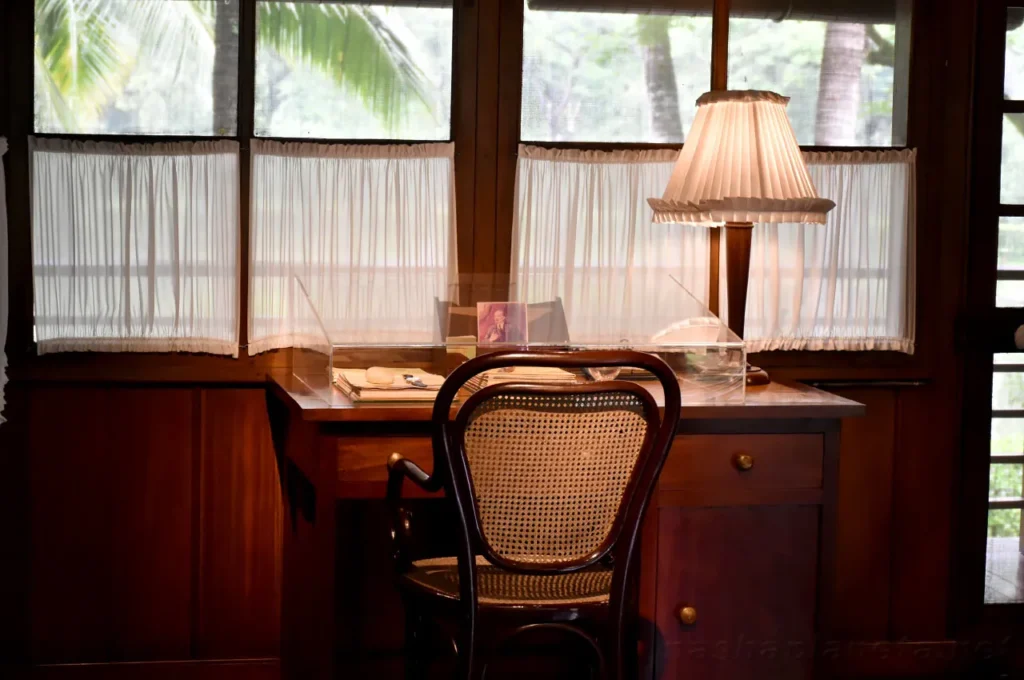
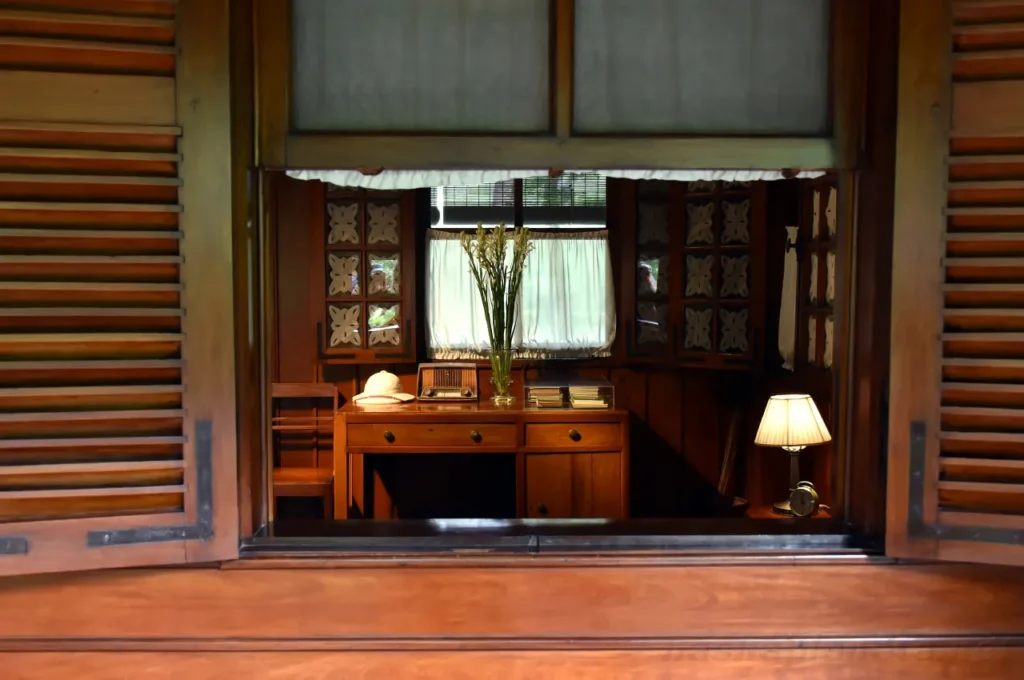
Ho Chi Minh lived and worked in this house until his death in September 1969. During these eleven years, important political discussions took place here, and decisions were made that shaped Vietnam’s future development. Today, the stilt house offers insights not only into Ho Chi Minh’s lifestyle but also into a significant period in Vietnamese history.
There are also reminders of Ho Chi Minh’s daily life outside the house. In the garden, he had a simple wooden bench installed to provide a meeting place for children. Details such as these show that the stilt house is not merely a memorial to a political figure but also offers a glimpse into the daily life and habits of its former resident.
The stilt house is therefore far more than a modest dwelling. In contrast to the imposing Presidential Palace, it embodies simplicity and a close connection with nature, offering a glimpse into the lifestyle of a man who profoundly shaped Vietnam’s history.
The Carp Pond – A Place of Tranquillity
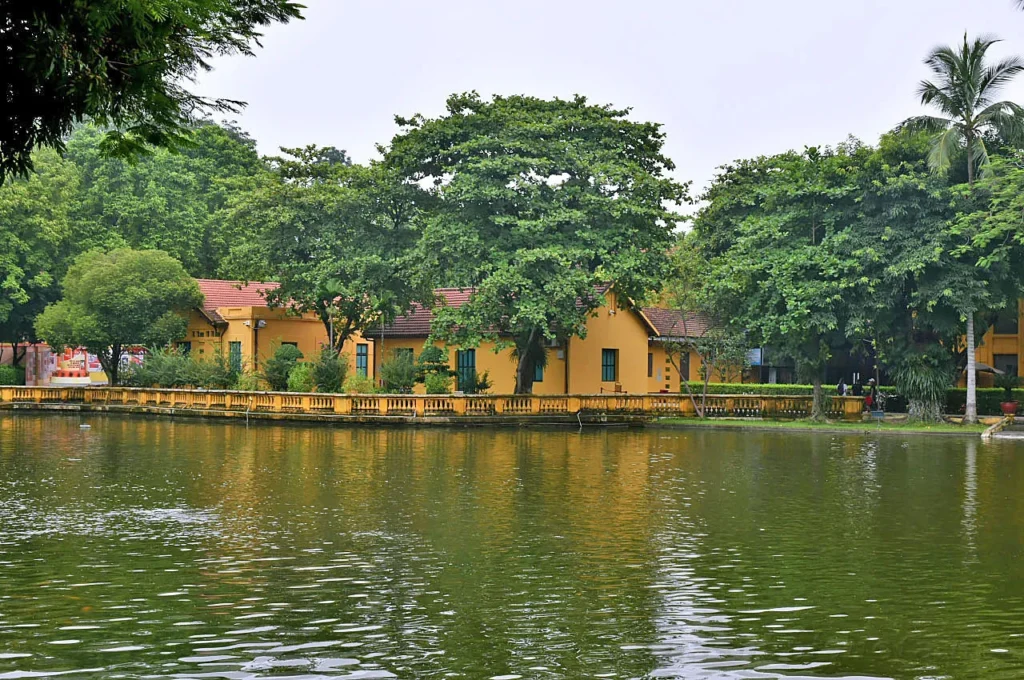
Just a few steps from the stilt house lies a small pond nestled between the stilt house and House 54. Covering an area of more than 3,000 square metres and reaching a depth of around two metres, it is a prominent feature of the garden. Surrounded by lush greenery, the pond provides a habitat for various fish species, including carp and Amur bitterling. Numerous carp swim through the water and often gather near the bank when visitors feed them.
The pond was maintained and landscaped at Ho Chi Minh’s initiative. What was once a little-used area thus became a harmonious part of the garden, highlighting the connection between nature and everyday life.
The carp pond is one of the most atmospheric spots in the entire complex. It symbolises the quieter, everyday side of a man who is otherwise associated primarily with political decisions, Vietnam’s independence, and the Vietnam War.
House 67 – Reminders of the Vietnam War
Another building on the grounds is House 67, a modest, pale green structure built in 1967 during the Vietnam War. Its construction was prompted by the growing threat of American air raids on Hanoi.
Commissioned by the political leadership, the building was constructed from reinforced concrete to provide particularly strong protection. Its walls are approximately 60 centimetres thick, and its roof is more than one metre thick. It was designed to protect Ho Chi Minh and members of the political leadership in the event of surprise air raids. The H66 air-raid shelter, which was connected to the house, stood directly beside it.
Ho Chi Minh initially did not want to use the building as his personal residence. Instead, House 67 served as a place of work and meetings for him and the political leadership. Important consultations took place here as the war increasingly shaped everyday life in Hanoi. From late August 1969 onwards, the house was also used for Ho Chi Minh’s medical treatment. He died there on 2 September 1969.
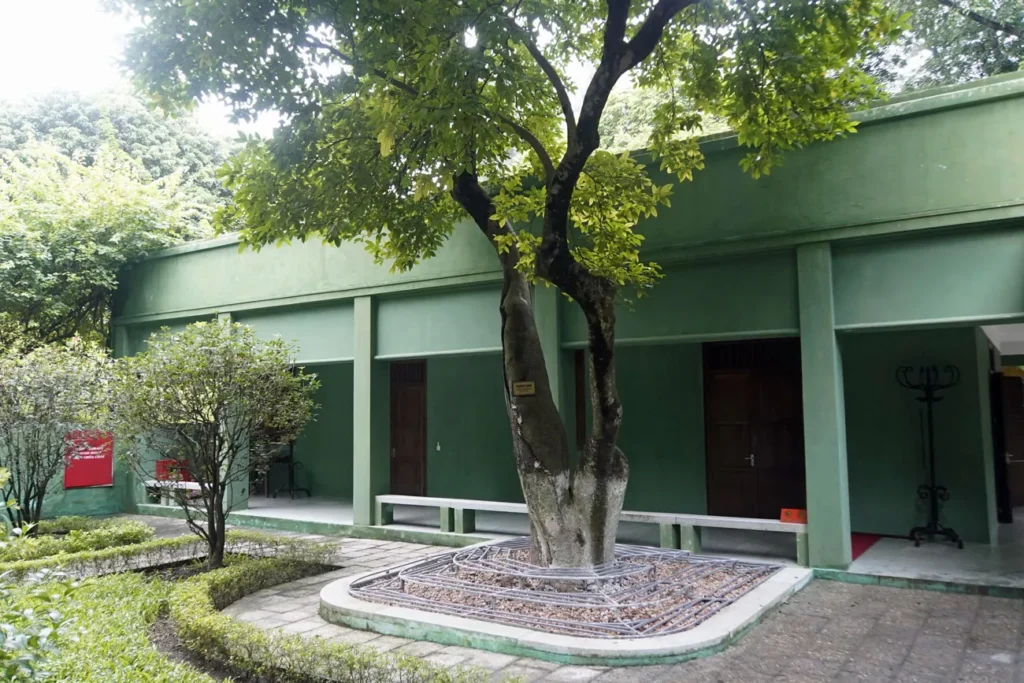
House 67 is a reminder of a period when the lives of both the political leadership and the wider population were shaped by the effects of war. In contrast to the peaceful garden and the modest stilt house, this building evokes the military threats of those years and the efforts made to protect the country’s leadership from the consequences of air raids.
A small medical station is also located nearby. During the final years of his life, Ho Chi Minh received treatment there and spent periods of time in one of its rooms.
A Walk Through the Park – Tropical Trees and Vibrant Nature
The grounds surrounding the Presidential Palace are far more than a green backdrop to the historic building. Towering old trees provide welcome shade, while ornamental gardens, flowering plants, and fruit trees create a varied landscape. A walking path approximately 200 metres long, known as Mango Alley, winds through the grounds, lined with imposing mango trees.
Some of the trees are particularly fascinating because of their unusual shapes. On certain trees, the roots rise from the ground like small walls or spread out from the trunk like sturdy supporting boards. Others have striking root projections that emerge from the soil, resembling miniature pyramids. Such formations can occur in certain tropical tree species and in bald cypresses, whose specialised structures, known as pneumatophores or breathing roots, help supply oxygen to the roots in waterlogged soils.
Among the towering trees are colourful blossoms, lush shrubs, and various fruit-bearing plants. The mango trees, which catch the eye even when viewing the palace, are also among the grounds’ distinctive features. The contrast between the formal architecture and the rich variety of vegetation lends the entire setting a special charm.
The park is therefore not only a place of tranquillity but also a living memorial. For many Vietnamese people, a visit is an opportunity to learn more about Ho Chi Minh and reflect on their country’s history.
A Venue for Political Meetings
During his time in office, Ho Chi Minh used the Presidential Palace as a venue for numerous official events and political meetings. He received heads of state, ambassadors, political delegations, and representatives from the fields of science, the arts, and sport, as well as members of various social groups.
The palace hosted cabinet meetings, political discussions, and official receptions. New Year’s addresses and other important speeches were also among Ho Chi Minh’s public duties.
Between 1954 and 1969, Ho Chi Minh received more than 1,000 delegations from Vietnam and abroad at the Presidential Palace. His guests included political representatives, artists, athletes, scientists, and journalists. His public appearances also included traditional greetings for Tết, the Vietnamese Lunar New Year, and the recitation of poems on this special occasion. These encounters illustrate the central role the Presidential Palace played in the country’s political and social life.
The various buildings within the complex reflect different aspects of Ho Chi Minh’s life and legacy: the palace represents the official functions of the state, House 54 and the stilt house offer insights into his private life, while House 67 provides a glimpse into the war years.
Since 1975, the stilt house and the carp pond have formed part of the historical memorial complex. The grounds thus preserve not only historic buildings and objects but also memories of Vietnam’s political development during the twentieth century.
Today, the Presidential Palace continues to serve an important ceremonial function. It hosts official receptions for foreign heads of state and high-ranking delegations. At the same time, the historic area where Ho Chi Minh lived and worked has been preserved as a memorial site and is open to visitors. In this way, the complex continues to combine its political significance with the memory of one of Vietnam’s most important leaders.
Summary
The Presidential Palace in Hanoi reflects Vietnam’s transformation from French colonial rule to independence and political self-determination.
The contrast between the imposing palace and Ho Chi Minh’s modest stilt house is particularly striking. While the palace represents power and authority, the stilt house and carp pond offer a glimpse into the more personal side of his life.
Walking through the surrounding park, visitors encounter different chapters of Vietnamese history, from the colonial era and the struggle for independence to the war years and Ho Chi Minh’s enduring legacy.
Combining architecture, nature, and history, the complex offers a vivid insight into Vietnam’s past and the life of one of its most influential leaders.