
STANAG 6001 Level 3 – Speaking Task (Discussion): The Future of the Car Industry
Examination Task
The car industry is facing a lot of challenges in the 21st century and it is constantly changing. Look at the list below and decide which solution is the most and the least likely to be developed in the future. Justify your choice.
- Electric cars
- Autonomous cars
- Flying cars
Sample Discussion
A: There are several solutions being developed in the car industry, such as electric cars, autonomous cars, and flying cars. Let’s discuss them and decide which is the most and the least likely to be developed in the future.
B: Yes, that sounds good. In my opinion, electric cars are definitely the most likely to dominate in the near future. We can already see a clear trend, especially in countries like China, where electric vehicles have become very common. Norway is the undisputed world leader in electric vehicle sales, with roughly 90% of new car sales being electric.
A: I see your point. Electric cars already have many advantages over traditional vehicles. They are more efficient, quieter, and more environmentally friendly since they do not produce exhaust emissions.
B: That’s true. What really drives this transition is not only technology but also political pressure and environmental concerns. The EU is introducing stricter environmental regulations, which is accelerating the shift towards electric mobility.
A: Exactly. However, one major issue is still the price. Electric cars are significantly more expensive than traditional vehicles, mainly because of battery production costs. That’s why most passenger cars in Poland still run on petrol or diesel.
B: I agree, the initial cost is still a serious barrier for many consumers. Even though running costs are lower, not everyone can afford such a high investment. Some countries introduced incentive schemes to encourage the purchase of electric vehicles. In Poland, there is currently a government subsidy of up to 40,000 PLN for the purchase of a new electric vehicle.
A: I believe that financial incentive schemes are crucial for encouraging the purchase of electric vehicles. There are currently around 140,000 fully electric cars on Polish roads, and this number is steadily increasing.
B: I agree, but there are still practical challenges, such as limited battery range, especially in cold weather, a small number of charging stations and points for electric vehicles and long charging times. This significantly complicates long-distance travel.
A: That’s true. Moving on to autonomous cars, I think they are also very promising, although their development may take more time due to technical and legal challenges.
B: Indeed, the introduction of autonomous vehicles on city streets requires the development and implementation of many legal regulations. Nevertheless, such cars could improve road safety and reduce human error.
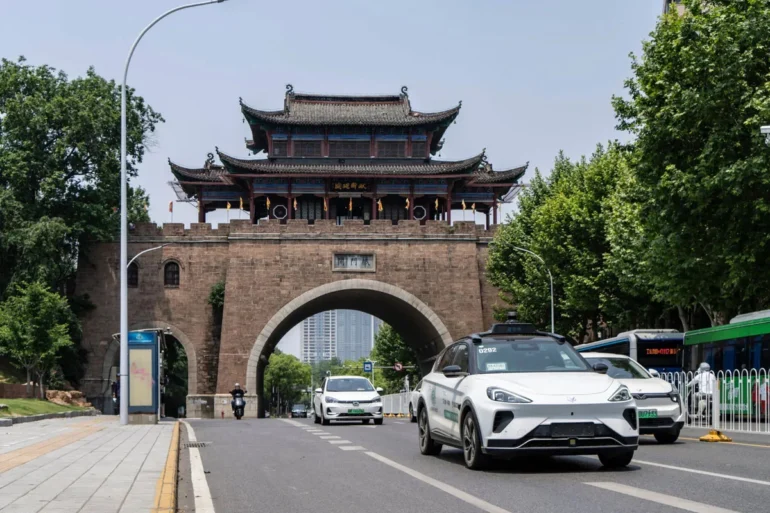
A: The leaders in autonomous vehicle development include the United States, where autonomous taxis are already operating commercially in cities such as San Francisco, Los Angeles, and Phoenix. In addition, China is rapidly advancing in this field, with robotaxi services becoming increasingly common in major cities like Wuhan, and development progressing faster than anywhere else in the world. As for Poland, autonomous vehicles have already been tested on public roads. However, road infrastructure still seems to be a major challenge. Roads need to be properly marked and well maintained to support such systems.
B: That’s interesting. It shows that the technology is not only theoretical but already being tested and even used in real-life environments in some countries.
A: Now, when it comes to flying cars, I believe they are the least likely to become common in the near future.
B: I completely agree. Electric cars are already a reality, whereas flying cars are still mostly experimental. However, it is worth noting that development in this area is progressing, especially in countries like the United States and China.
A: That’s true. Some companies are already testing vehicles that can both drive on roads and fly, or small air taxis designed for short-distance transport. In theory, this could reduce traffic congestion in big cities.
B: Yes, and they could also be useful in specific cases, such as emergency services or medical transport, where speed is crucial.
A: I agree they could be useful; however, the challenges are still huge. Cities would need take-off and landing areas and systems to manage air traffic at low altitudes. Governments would also need to introduce legal frameworks for the safe operation of flying cars, which could take many years.
B: Exactly. Safety is a big concern. Operating a large number of flying vehicles over cities could be very risky, especially in bad weather or in case of technical failures.
A: I agree, and cost is another limiting factor. Flying cars are likely to be extremely expensive, both in terms of production and operating costs, which means they would only be accessible to a very small group of users.
B: That’s a good point. There are also concerns about noise and environmental impact, especially in densely populated urban areas.
A: Without a doubt, operating a large fleet of flying vehicles over cities would still raise serious concerns about noise pollution, potentially disturbing both residents and birds, even if these vehicles were electric rather than combustion-powered.
B: So, to sum up, electric cars are the most likely to be widely developed because they are already available and strongly supported by governments, despite their high initial cost. Autonomous cars come next, while flying cars remain the least realistic option due to infrastructure, safety, and cost issues.
A: I completely agree.
Photo: Self-driving robotaxis in Wuhan, China © Qilai Shen