
In an increasingly interconnected world, languages do more than facilitate communication – they shape identities, economies, and global relationships. Among them, French continues to stand out as a dynamic and influential global language. According to the latest 2026 report by the International Organisation of La Francophonie (OIF), French is now the fourth most widely spoken language in the world, with an estimated 396 million speakers. It ranks just behind English, Mandarin Chinese, and Spanish, and has even surpassed Arabic in total number of users.
What makes this figure particularly interesting is the updated methodology used to calculate it. For the first time, the OIF includes children aged 6 to 9 who are being educated in French in regions where the language serves as an official, co-official, or instructional medium. This adjustment reflects a broader and more forward-looking understanding of what it means to be a “speaker” in today’s world.
One of the most striking aspects of the global French-speaking community is its geographic distribution. While France itself accounts for around 66 million speakers, nearly 65% of all francophones live in Africa. Countries such as the Democratic Republic of the Congo, Algeria, and Morocco play a central role in this linguistic landscape. In fact, the future of French is increasingly tied to the African continent. Demographic trends suggest that by 2050, the number of French speakers could reach 590 million, with nine out of ten living in Africa. This shift signals a profound transformation: the evolution of French will be shaped less by Paris and more by cities like Kinshasa, Dakar, Abidjan, and Yaoundé.
French is also a language of learning. It is currently the second most widely studied foreign language in the world, with nearly 170 million learners. This widespread interest reflects its continued importance in international diplomacy, tourism, and global affairs. Moreover, French remains the third most important language in business and economic relations, offering tangible advantages for those seeking to build international partnerships.
However, the position of French is not without challenges. In fields such as science, technology, and higher education, English continues to dominate. Similarly, in the digital sphere, although French ranks fourth among languages used online, it represents only about 3.5% of internet content. This highlights the need for continued investment in digital innovation and content creation to ensure the language remains visible and relevant in the modern world.
Despite these challenges, the overall trajectory of French is one of growth and renewal. The number of speakers has steadily increased over recent decades – from 220 million in 2010 to over 320 million in 2022, and now approaching 400 million. Importantly, only about 90 million people speak French as their first language, meaning that the vast majority use it alongside other languages. This multilingual reality contributes to the richness and diversity of the Francophone world.
French is a language that travels, connects, and reinvents itself. Spoken across five continents, it continues to evolve through countless cultural and linguistic contexts. From classrooms in Africa and Asia to business hubs in Europe and the Americas, French serves as a powerful tool for education, inclusion, and development.
Beyond demographics, institutional support plays a crucial role in promoting the French language and culture. A global network of Instituts français and Alliances françaises actively contributes to this mission. These institutions organize language courses, cultural events, exhibitions, and artistic collaborations, helping to maintain the visibility and attractiveness of French across continents. By fostering intercultural dialogue and supporting local initiatives, they ensure that French remains not only a language of communication, but also a vibrant vehicle of cultural exchange and creativity.
In the 21st century, being a French speaker is not defined by geography, but by participation in a global community. As the language continues to grow – both in numbers and in diversity – it remains a living, adaptable, and creative force in our rapidly changing world.
Source: Rapport quadriennal « La langue française dans le monde 2026 », Organisation internationale de la Francophonie (OIF), Éditions Gallimard
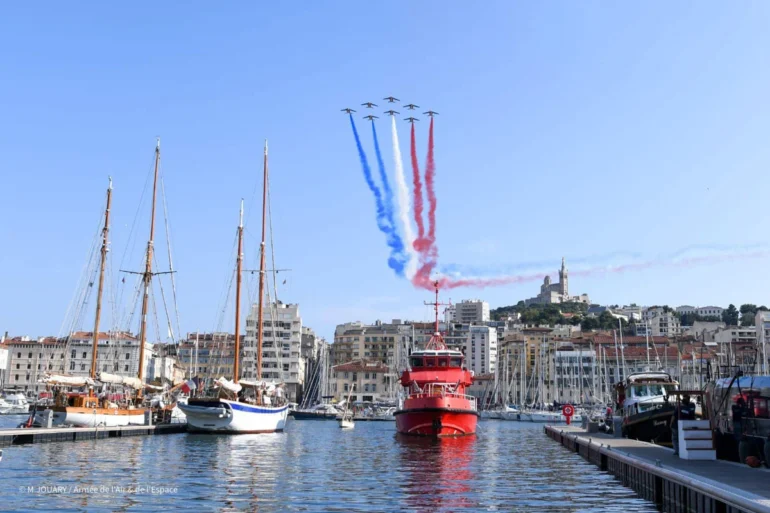
Photo: Patrouille de France (French Acrobatic Patrol) above the Old Port of Marseille © M. Jouary, Armée de l’air et de l’espace (French Air and Space Force)