
STANAG 6001 Level 3 – Speaking Task: Briefing on Maritime Reconnaissance Options
Examination Task
While on a mission abroad your unit is stationed at a base at the seaside. You have been informed about the increasing danger of enemy vessels breaching the sea border. Due to that fact, there is a need for regular reconnaissance of the area. Give a briefing on two possible ways of doing it, describing their advantages and disadvantages. Recommend one and justify your choice.
- air patrols
- sea patrols
- other
Sample Briefing
Good morning, ladies and gentlemen.
First of all, thank you for attending this briefing. My name is Captain Taylor and I am responsible for coordinating reconnaissance activities at our base. As you have been informed, our unit is currently stationed at a seaside base during an overseas mission. Recently, intelligence reports have indicated an increasing risk of enemy vessels attempting to breach the sea border in our area of responsibility. For this reason, regular reconnaissance of the surrounding maritime area has become essential.
I have been tasked with presenting two possible ways of conducting such reconnaissance. In this briefing, I will discuss the advantages and disadvantages of air patrols and sea patrols, and finally I will recommend the most suitable option.
Let me begin with the first option, which is conducting air patrols.
This solution offers several advantages.
Firstly, air patrols allow us to monitor a large area of the sea in a relatively short time. They can cover vast distances quickly and detect numerous vessels, providing wide coverage of the operational area.
Secondly, aerial reconnaissance provides a more detailed and accurate overview thanks to advanced sensors, radar systems, and imaging equipment installed on patrol aircraft or drones. This enables the detection of suspicious activity with greater precision and supports timely decision-making.
However, air patrols also have certain disadvantages.
To begin with, they are relatively expensive due to fuel consumption, aircraft maintenance, and the need for trained aircrews. Additionally, aircraft cannot remain in the air indefinitely, which means that patrols must be carefully scheduled and may leave temporary gaps in surveillance.
I will now move on to the second option, which is conducting sea patrols.
One major advantage of sea patrols is their constant presence in the monitored area. Patrol boats can remain at sea for extended periods of time, which ensures continuous surveillance near critical points such as harbours or shipping routes.
Moreover, naval patrol units are able to directly intercept suspicious vessels, if necessary, which makes them highly effective in enforcing maritime security.
On the other hand, sea patrols also have some drawbacks.
Firstly, their operational range is limited compared to aircraft, which means that they can cover a much smaller area.
Secondly, their speed is significantly lower than that of aircraft, so detecting and responding to distant threats may take considerably more time.
To sum up, both options have clear advantages and disadvantages. Nevertheless, I would recommend air patrols as the primary method of reconnaissance. Although they are more expensive, they provide faster detection and allow us to monitor a much larger area of the sea. Early identification of potential threats would give our forces more time to react and prepare an appropriate response.
This brings me to the end of my briefing.
If you have any questions, I will be happy to answer them.
Thank you for your attention.
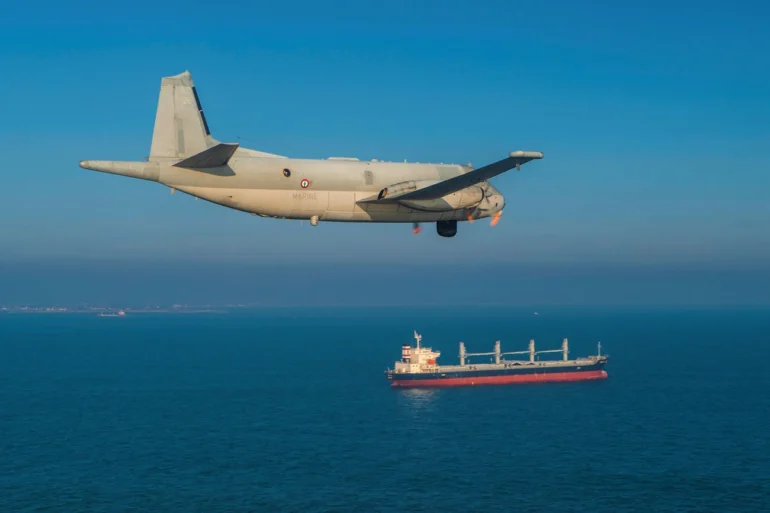
Photo: Breguet Atlantique 2 (ATL 2), French long-range maritime patrol and reconnaissance aircraft © EUNAVFOR