
STANAG 6001 Level 3 – Speaking Task: Briefing on Training Options for Cooperation with a Lithuanian Unit
Examination Task
Your company is going to cooperate with a Lithuanian unit on a peacekeeping mission abroad. You are responsible for preparing the soldiers for the event. Give a briefing on two possible options, describing their advantages and disadvantages. Recommend one and justify your choice.
- organize training for Polish troops only
- organize training with the Lithuanian unit
- other
Sample Briefing
Good morning, ladies and gentlemen.
Thank you for attending this briefing. My name is Captain Johnson and I am responsible for preparing our soldiers for the upcoming peacekeeping mission abroad.
As you know, our company will be cooperating with a Lithuanian unit during this mission. The command has asked me to present possible options for preparing our troops effectively.
I have divided my briefing into two parts. In the first part, I will discuss the option of organizing training for Polish troops only. In the second part, I will present the possibility of conducting joint training with the Lithuanian unit. Finally, I will recommend the solution which I believe will best prepare our soldiers.
Let me begin with the first option, which is training Polish troops only.
This option has several advantages.
Firstly, it allows for focused preparation tailored to our company’s specific needs and standard operating procedures. The training can be conducted in Polish, which makes communication easier and more efficient.
Secondly, organizing training for our troops only is simpler logistically. There is no need to coordinate schedules, facilities, or training content with another unit, which can save time and resources.
However, this option also has some disadvantages.
To begin with, our soldiers will not have the opportunity to practice cooperation with the Lithuanian unit before the mission. This could result in misunderstandings or delays when operating together in the field.
Another drawback is that differences in tactics, procedures, and communication protocols may not be addressed during training, which could reduce overall mission effectiveness.
I will now move on to the second option, which is organizing joint training with the Lithuanian unit.
This solution offers several advantages.
Firstly, joint training allows soldiers from both units to become familiar with each other’s procedures, tactics, and communication methods. This significantly improves coordination and operational effectiveness during the mission.
Secondly, working together in training can strengthen mutual trust and build interpersonal relationships, which are crucial for smooth cooperation under operational conditions.
On the other hand, this option also has some disadvantages.
Firstly, organizing joint training is more complicated logistically. Coordination of schedules, accommodation, language support, and suitable training facilities requires additional effort and planning.
Secondly, joint training may take more time and could require adjustments to address differences in doctrine, training methods, or operational priorities.
To sum up, both options have their merits. However, I would recommend organizing joint training with the Lithuanian unit.
Although this option may be more complex and time-consuming, it promotes effective cooperation, mutual understanding, and operational readiness. In the long term, it will help our soldiers perform more efficiently and safely during the mission, ensuring that the objectives of the peacekeeping operation are met.
This brings me to the end of my briefing.
If you have any questions, I will be happy to answer them.
Thank you for your attention.
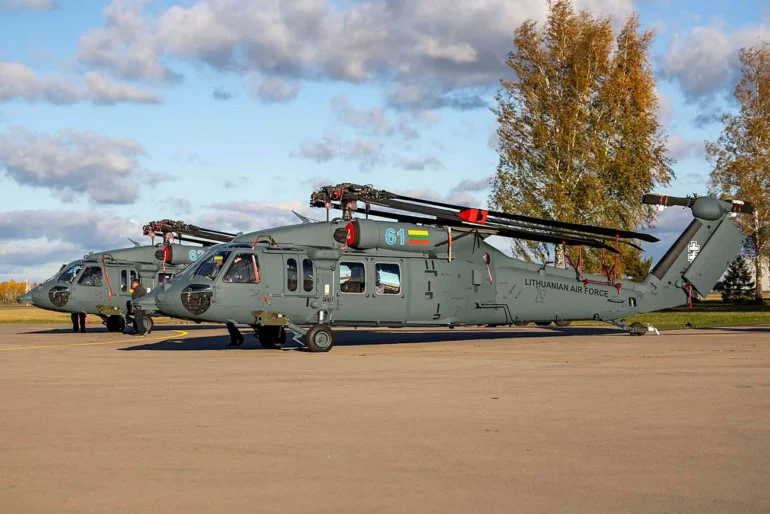
Photo: Sikorsky UH-60M Black Hawk helicopters purchased by Lithuania from the USA © Lithuanian Armed Forces (Lietuvos kariuomenė)