
In periods when Iran, officially the Islamic Republic of Iran, dominates international news, its name is heard repeatedly in speeches, press briefings, and television coverage. During the current wave of reporting on the military strikes against Iran that began on 28 February 2026, many listeners have noticed something intriguing: American officials and commentators sometimes pronounce the country’s name as /aɪræn/ (“eye-ran”), while others say /ɪˈrɑːn/ or /ɪˈræn/ (“ih-RAHN” or “ih-RAN”).
This variation is not merely an accident. It reflects several layers of linguistic influence: English phonetics, regional accents, media habits, and the distance between English and the Persian original.
The Standard English Pronunciation
In dictionaries and linguistic descriptions of modern English, including Longman Pronunciation Dictionary, the most widely accepted pronunciation places the stress on the second syllable:
- /ɪˈrɑːn/ – often heard in British English (“ih-RAHN”)
- /ɪˈræn/ – common in American English (“ih-RAN”)
In both versions, the first vowel is the short /ɪ/ sound, like the vowel in it or in, and the stress falls on the second syllable.
This pattern reflects the Persian pronunciation /iːˈrɒːn/, which likewise emphasizes the second syllable and begins with a high front vowel similar to “ee.”
In other words, the linguistically expected pattern in English is:
ih-RAN / ih-RAHN
not
EYE-ran
Where Does “Eye-ran” Come From?
The pronunciation /aɪræn/ (“eye-ran”) emerges largely from the way English speakers interpret spelling. English often pronounces the letter i at the beginning of a word as /aɪ/, as in: iron /ˈaɪən/ or island /ˈaɪlənd/.
When speakers apply this pattern mechanically to the spelling Iran, they produce “eye-ran.”
This is an example of a broader phenomenon in linguistics, that is, analogy with familiar spelling-sound patterns. Speakers unconsciously treat unfamiliar words as if they followed the same phonetic rules as common English vocabulary.
Media and Political Speech
Pronunciation trends can spread rapidly through the media. When prominent broadcasters or political figures consistently use a particular form, it becomes familiar to millions of listeners.
Historically, during periods of intense political attention – such as the 1979 Iranian Revolution and the hostage crisis – some American broadcasters frequently used the “eye-ran” pronunciation, which then circulated widely in public discourse.
For linguists, this variation is a reminder that pronunciation is shaped not only by dictionaries but also by history, media influence, and the phonetic instincts of speakers.
Over time, many journalists and diplomats moved toward pronunciations closer to the Persian original, such as “ee-RAHN” or “ih-RAHN.” Yet variation still persists in American political speech, especially in unscripted comments or regional dialects.
Which Pronunciation Should Be Recommended?
From a linguistic perspective, the pronunciation that places the stress on the second syllable is generally considered the most appropriate in English. The forms /ɪˈrɑːn/ (“ih-RAHN”) in British English and /ɪˈræn/ (“ih-RAN”) in American English both reflect the stress pattern of the Persian original Īrān.
For that reason, many linguists, language guides, and international broadcasters recommend avoiding the spelling-driven pronunciation /aɪræn/ (“eye-ran”). Although it is widely understood and occasionally heard in American speech, it diverges from both the original Persian pronunciation and the pronunciation traditionally recorded in major dictionaries.
In formal contexts such as journalism, diplomacy, academic writing, or international broadcasting the most advisable choice is therefore:
/ɪˈrɑːn/ or /ɪˈræn/
Promoting this pronunciation helps maintain consistency with the original language and aligns English usage with established pronunciation standards.
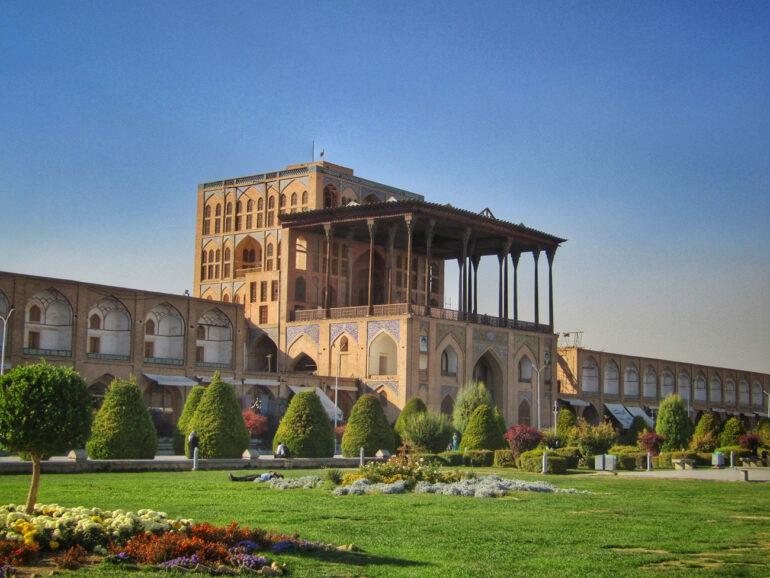
Photo: Exterior view of the Ali Qapu Palace in Isfahan, built during the Safavid era under Shah Abbas I in the early 17th century.