
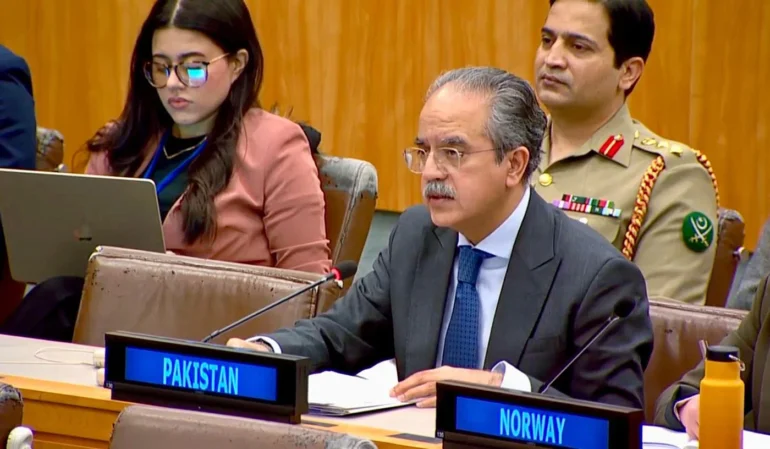
On 18 February 2026, at the opening of the Special Committee on Peacekeeping Operations, the Permanent Representative of Pakistan to the United Nations Ambassador Asim Iftikhar Ahmad called for renewed commitment to peacekeeping and predictable financing. He warned that current financial constraints risk weakening the organization’s ability to protect civilians and stabilize conflict zones.
Ambassador Ahmad stressed that UN peacekeeping remains one of the world body’s most valuable tools for maintaining international peace and security. Peacekeeping missions, he noted, have protected civilians and enabled political dialogue in some of the most complex conflicts. However, these operations now face increasing political, operational and financial pressures that require collective action.
Speaking from Pakistan’s extensive experience in peace operations, the ambassador recalled the country’s long-standing contribution to UN missions, including the United Nations Military Observer Group in India and Pakistan in Jammu and Kashmir. Over six decades, more than 250,000 Pakistani peacekeepers have served in 48 missions across four continents, and 182 personnel have made the ultimate sacrifice under the UN flag. This commitment, he said, reflects Pakistan’s belief in multilateralism and collective security.
The ambassador highlighted concerns about the evolving environment for peacekeeping. While missions have transitioned or downsized in recent years, no new UN operation has been established for over a decade despite rising global instability. Non-UN and ad-hoc missions continue to appear, demonstrating ongoing demand for peace support. The central issue, he argued, is political resolve rather than the relevance of peacekeeping itself.
Financial pressures pose a major challenge. The UN’s liquidity crisis has led to contingency measures that reduce troop deployments and civilian staff in missions, directly affecting patrols and field presence. Such reductions undermine mandate implementation, particularly the protection of civilians and deterrence of violence, and also place peacekeepers’ safety at risk.
Ambassador Ahmad urged the Special Committee to reaffirm the principle that mandates authorized by the Security Council must be matched with predictable resources. He called for a structured review of the financial architecture supporting peace operations to ensure sustainability and operational effectiveness.
He also emphasized the strategic balance between financial contributions and troop contributions. If funding commitments decline and missions contract without clear direction, troop-contributing countries may reduce their readiness to deploy forces. Standby arrangements and rapid deployment capabilities require sustained investment to remain viable; otherwise, the UN risks losing its ability to mobilize peacekeepers when crises emerge.
The ambassador further noted the special responsibility of permanent members of the Security Council in maintaining international peace and security. Historically, these members have provided limited personnel for peacekeeping operations. If they were to withdraw financial support as well, questions could arise about the equitable distribution of responsibilities within the UN system.
Reform of peacekeeping, he acknowledged, is necessary to adapt to evolving threats and enhance operational efficiency. However, reforms must be based on collective decision-making and should strengthen core capabilities rather than dilute them. Technological innovation and partnerships can improve effectiveness, but the fundamental objectives of peacekeeping must remain intact.
Protection of civilians, ceasefire monitoring and deterrence of violence remain the cornerstone tasks of UN missions. In fragile environments, the presence of peacekeepers often provides stability and space for political solutions. Lack of political progress should not be used as justification for withdrawing missions; instead, efforts should focus on encouraging parties to comply with Security Council resolutions.
Pakistan expressed readiness to work constructively with all member states to produce meaningful recommendations from the Special Committee. Ambassador Ahmad concluded by emphasizing the importance of keeping the forum active and consensus-oriented, noting that strong peacekeeping policy is essential for addressing contemporary security challenges.
The discussions at the committee come amid broader debates on the future of UN peace operations and the need to ensure they remain adequately funded and strategically aligned with global security realities. As geopolitical tensions persist, the role of UN peacekeeping continues to attract international attention, with member states seeking solutions that enhance its effectiveness and sustainability.
Photo: Pakistan’s Permanent Representative to the UN, Asim Iftikhar Ahmad, Special Committee on Peacekeeping Operations, Feb. 20, 2026. (@PakistanUN_NY/X)