
Every year on November 1st, France observes La Toussaint, or All Saints’ Day, a tradition deeply rooted in both Christian heritage and national culture. Although it is officially a religious feast honouring all saints, La Toussaint has evolved into a broader cultural event – one that intertwines spirituality, family remembrance, and a reflection on mortality. It remains a public holiday in France and holds a unique place in the nation’s collective consciousness.
Historical and Religious Origins
The origins of La Toussaint date back to the early Middle Ages. In the 8th century, Pope Gregory III designated November 1st as a day to venerate all saints, particularly those without their own feast day. Initially introduced in Rome, this new observance reflected the growing desire to commemorate the multitude of martyrs and holy figures whose names were not recorded in the official calendar. This decision was later formalized by Pope Gregory IV, who extended the celebration to the entire Christian world, ensuring that All Saints’ Day became a universal feast within the Church’s liturgical calendar. France, as a historically Catholic country, integrated this observance deeply into its culture.
Yet over time, La Toussaint came to encompass more than the commemoration of saints. It also became associated with honouring the dead, blending religious devotion with a universal human impulse – remembrance.
The Commemoration of the Dead
While La Toussaint is officially distinct from Le Jour des Morts (All Souls’ Day, November 2nd), in practice, the two have merged. On La Toussaint, families across France visit cemeteries to pay tribute to deceased relatives. They clean the tombs, place candles, and adorn graves with chrysanthemums, a flower that has become the emblem of remembrance and immortality.
This ritual creates a landscape of striking colour and symbolism: entire cemeteries bloom with chrysanthemums in shades of gold, violet, and white. The custom reflects not only a Catholic tradition but also a broader cultural reverence for ancestry and continuity.
A National Holiday and Family Gathering
La Toussaint is a jour férié (a public holiday) meaning that most schools, banks, and offices are closed. It coincides with the autumn school break, commonly known as les vacances de la Toussaint, which lasts around two weeks. For many families, this is an opportunity to travel, reunite with relatives, or simply enjoy a moment of rest.
In this sense, La Toussaint carries both spiritual and social dimensions: it is a time for reflection and mourning, yet also for togetherness and familial bonds. The calm rhythm of early November between the end of harvest and the onset of winter reinforces this contemplative atmosphere.
Modern Transformations and Coexistence with Halloween
In recent decades, La Toussaint has coexisted with the growing influence of Halloween – a largely secular celebration of pagan origin, rooted in Anglo-Saxon culture and observed on October 31, centered primarily on costumes and sweets. The name Halloween most likely comes from All Hallows’ Eve, meaning the eve of All Saints’ Day. The custom of celebrating this holiday was probably introduced by Celtic priests who believed that the dead who had not reached heaven returned to earth on the day before All Saints’ Eve to ask for prayers.
The symbol of Halloween is a hollowed-out pumpkin with holes carved in its shell resembling eyes, a nose, and usually a jagged mouth, with a lit candle placed inside. Halloween’s playful and commercial character contrasts sharply with the solemn tone of La Toussaint.
Due to the pagan origins of Halloween, the Catholic Church in many countries views Halloween with reluctance. In the teaching of the Catholic Church, some practices associated with Halloween glorify death and the occult, which are considered contrary to the principles of faith.
For older generations, La Toussaint remains sacred and reflective; for younger ones, it is often linked to school holidays and informal family gatherings. Despite these changes, the act of visiting cemeteries and placing flowers endures as a powerful symbol of remembrance.
A Reflection on Life and Memory
Ultimately, La Toussaint transcends its religious origins. It has become a moment of national introspection, inviting people to pause and reflect on the passage of time, the fragility of life, and the enduring presence of those who came before. The stillness of cemeteries, the scent of chrysanthemums, and the grey skies of November together create an atmosphere that is both melancholic and serene.
In honouring the saints and the departed, La Toussaint reminds the French of their shared history and the values of continuity, respect, and remembrance. It is a day that bridges faith and culture, the sacred and the personal – a profound expression of how a society keeps memory alive.
Conclusion
La Toussaint stands as one of France’s most meaningful observances, uniting the spiritual and the secular, the collective and the intimate. Whether celebrated through religious ceremony, a quiet visit to a cemetery, or a simple family gathering, it remains a powerful ritual of remembrance. In a rapidly changing world, La Toussaint continues to offer a timeless space for reflection – on loss, legacy, and the enduring connection between the living and the dead.
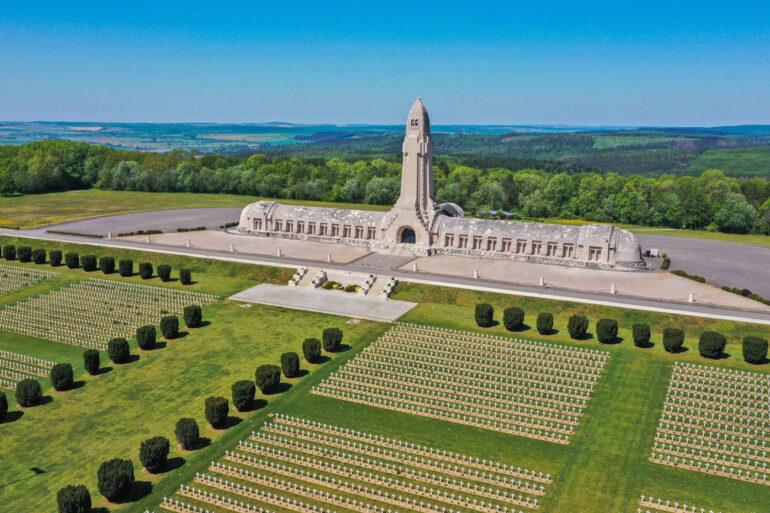
Photo: Douaumont Ossuary, a memorial containing remains of soldiers who died on the battlefield during the Battle of Verdun in World War I.