
In recent years, the concept of the Polar Silk Road has emerged as a significant element of global trade, driven by shifts in the Arctic environment and geopolitical developments. As global warming melts the ice in the Arctic, new maritime routes are opening up, presenting a faster, more efficient alternative to traditional shipping lanes.
The Polar Silk Road, part of China’s Belt and Road Initiative (BRI), seeks to connect Europe and Asia via the Arctic, avoiding politically unstable regions and reducing the risks posed by geopolitical tensions. This new trade route is not only a strategic opportunity for economic cooperation but also a potential game-changer in the dynamics of international trade.

The Concept of the Polar Silk Road
The Polar Silk Road is essentially an extension of the ancient Silk Road, but instead of a land-based network of routes, it uses the Arctic Sea lanes as a new route for global trade. The Northern Sea Route (NSR), running along Russia’s Arctic coast, is the most notable of these routes. Due to the ongoing impact of climate change, the Arctic ice cap is receding, making these routes more navigable, especially during the summer months, which reduces the need for icebreakers and opens up faster shipping options.
This new trade route is gaining importance as it offers several advantages over traditional maritime routes. The Polar Silk Road provides a shorter, more direct route from Asia to Europe, bypassing conventional chokepoints like the Suez Canal and the Strait of Malacca.
Avoiding Politically Unstable Regions
One of the most attractive features of the Polar Silk Road is that it helps bypass regions that are often affected by political instability or geopolitical conflicts. Traditional trade routes, such as those passing through the Suez Canal, the Strait of Malacca, or around the Cape of Good Hope, are vulnerable to various disruptions, including piracy, political conflicts, and regional instability.
For instance, the Suez Canal has been a hotspot for geopolitical tensions, particularly in the Middle East. Piracy and territorial disputes are prevalent in the waters surrounding the Strait of Malacca. Similarly, the route around the Cape of Good Hope, while avoiding the conflict-prone Middle East, involves long detours that add both time and cost to shipping.
In contrast, the Polar Silk Road offers a more secure alternative, as the Arctic region is largely free from the types of geopolitical tensions that affect traditional trade routes. This makes the Polar Silk Road a particularly appealing option for international shipping, offering the promise of safer, faster, and more predictable trade flows.
Economic Benefits of the Polar Silk Road
The potential economic benefits of the Polar Silk Road are immense. One of the most immediate advantages is the significant reduction in travel time for shipping. For example, a container ship traveling from the port of Ningbo-Zhoushan in China to the port of Felixstowe in the United Kingdom can complete the journey in just 18 days via the Northern Sea Route.
This is a drastic reduction compared to the traditional maritime routes, which take around 40 days when traveling through the Suez Canal, or around 50 days when going around the Cape of Good Hope. Moreover, rail transport from China to Europe takes approximately 25 days, offering another comparison to the faster Arctic route.
The shortened journey time has several economic implications. Faster shipping means goods can reach markets more quickly, reducing inventory costs and improving supply chain efficiency. This is particularly valuable for industries dealing with perishable goods or just-in-time manufacturing processes, where speed is a critical factor. The cost savings from faster shipping also translate into reduced operational costs, which can be passed on to consumers, creating more competitive pricing in international markets.
In addition to speed, the Polar Silk Road provides a safer and more predictable route. By avoiding regions prone to piracy, terrorism, or military conflict, the Arctic route offers a more stable environment for international trade. This is particularly important for large-scale global supply chains that require reliability and consistency.
From China to Northern Europe in 18-20 days
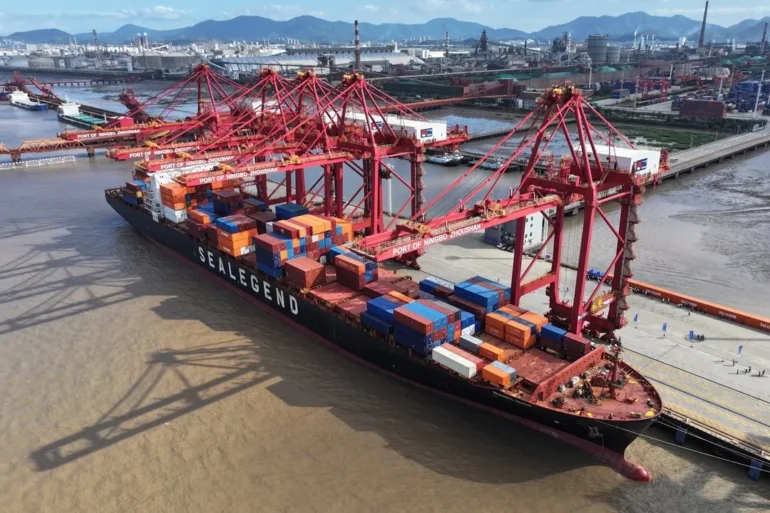
In August 2025, the Singaporean shipowner Sea Legend has announced the launch of a test container service via the Northern Sea Route that runs along the northern coast of Russia. The route is expected to reduce transport time from China to Northern Europe to 18–20 days. Sea Legend plans to maintain seasonal Arctic connections from May to October starting next year.
The container ship Istanbul Bridge departed from Ningbo-Zhoushan Port in east China’s Zhejiang Province on 22 September 2025 to Felixstowe, the largest container port in the UK. The cargo is expected to arrive in Felixstowe on 10 October 2025 and to set a new record for shipping time from Ningbo to Northern Europe at just 18 days. The overall goal is to establish a regular Arctic route linking major Chinese ports – including Ningbo-Zhoushan, Shanghai, and Qingdao – with key European ports such as Felixstowe, Rotterdam, Hamburg, and Gdańsk.
The Strategic Role of the Arctic
The strategic importance of the Arctic has grown exponentially in recent years. As the ice recedes, the region is not only becoming a more viable shipping route, but it is also home to valuable natural resources, including oil, gas, and rare earth minerals. These resources have become more accessible as the region warms, and countries with interests in the Arctic, such as Russia, the United States, Canada, and China, are increasing their presence in the area.
China’s growing involvement in the Arctic is driven by both commercial and strategic goals. Through investments in Arctic infrastructure, including icebreakers, ports, and supply bases, China is positioning itself as a major player in this emerging trade route. Moreover, China has increased its presence in the Russian Far East, working with Russia to develop the Northern Sea Route and create new trade hubs in the region.
For China, the Polar Silk Road is not just about securing faster shipping routes to Europe; it is also about gaining access to Arctic resources. These resources are vital for China’s industrial and technological needs, and having a direct route to them through the Arctic could greatly reduce the cost and complexity of resource extraction and transport.
Environmental Considerations and Challenges
Despite its potential, the Polar Silk Road faces a number of environmental and logistical challenges. The Arctic region is fragile, and increased shipping traffic could pose serious risks to its delicate ecosystems. Oil spills, waste from ships, and disruptions to wildlife are among the environmental concerns associated with the rapid expansion of shipping in the region.
Moreover, although climate change is making the Arctic more accessible, the region’s extreme weather conditions and unpredictable ice patterns still present significant challenges to shipping. Icebreaker ships, which are necessary for clearing paths through ice-choked waters, are expensive to operate, and delays caused by shifting ice or severe weather could disrupt the flow of goods along the route.
The geopolitical situation also adds a layer of complexity. While the Arctic is largely peaceful compared to other regions, there are competing territorial claims among Arctic nations over parts of the sea and its resources. International cooperation will be essential to ensure the sustainable and peaceful development of the Polar Silk Road. However, the increasing involvement of non-Arctic nations, particularly China, could lead to tensions in the future.
Conclusion
The Polar Silk Road represents a transformative shift in global trade, offering faster, more secure, and economically viable shipping routes between Europe and Asia. By bypassing politically unstable regions and providing an alternative to traditional maritime chokepoints, it reduces the risk of geopolitical disruptions. The Arctic offers vast potential, both as a shipping route and a source of valuable natural resources.
The route provides the shortest maritime link between China and Europe. However, the development of the Polar Silk Road comes with its own set of challenges. Environmental concerns, unpredictable weather, and geopolitical tensions in the Arctic must be carefully managed to ensure that the benefits of this new trade route are realized sustainably. As the Arctic continues to thaw, the Polar Silk Road will likely become an increasingly important artery for global trade, reshaping the future of international commerce.
Photo: The container ship Istanbul Bridge at the Ningbo-Zhoushan Port in China © Ningbo Zhoushan Port