
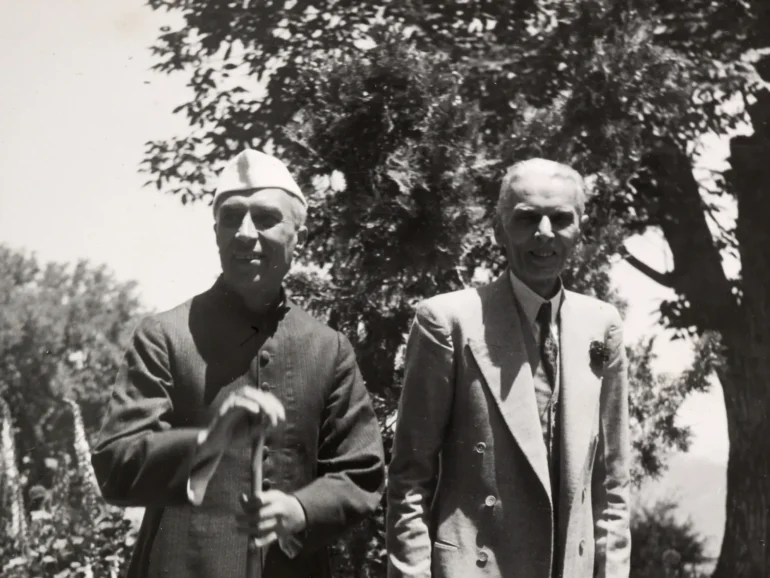
Muhammad Ali Jinnah (1876–1948) was a lawyer, politician, and the founder of Pakistan. He served as leader of the All-India Muslim League from 1913 until Pakistan’s independence on 14 August 1947, and as Pakistan’s first Governor-General until his death. He played a decisive role in the creation of a separate Muslim state on the Indian subcontinent.
Early Life and Education
Ali Jinnah was born in 1876 in Karachi, then part of British-ruled India, into a prosperous merchant family. He received his early education at the Sindh Madrasa and the Christian Missionary Society High School in Karachi. In 1893, he was sent to London to join Graham’s Shipping and Trading Company, a firm that had business ties with his father’s company. However, within a few months of his arrival, Jinnah gave up the business apprenticeship in order to study law. He enrolled at Lincoln’s – one of the most prestigious legal institutions in Britain. In London Jinnah had discovered a passion for nationalist politics and had assisted Dadabhai Naoroji, the first Indian Member of Parliament. After his return from England to India in 1896, he practised law at the Bombay Bar and was then the only Muslim barrister in Bombay.
Jinnah’s early career was marked by his advocacy for Hindu-Muslim unity. He initially joined the Indian National Congress (INC), aiming to bridge the gap between India’s Hindu and Muslim communities. He was a strong proponent of constitutional reforms and believed in the importance of Indian self-rule within the British Empire. During this period, he also played a key role in drafting the Lucknow Pact of 1916, which aimed to secure political rights for Muslims within the broader framework of British India.
Transformation from Hindu-Muslim Unity to the Two-Nation Theory
Jinnah’s political ideology began to evolve after his involvement in various political and constitutional debates. Early in his career, Jinnah worked closely with leaders like Mahatma Gandhi and Jawaharlal Nehru of the Indian National Congress, promoting unity between Hindus and Muslims. However, his disillusionment with the Congress and the increasing communal tensions in the subcontinent pushed him toward a more distinct vision for India’s future.
By the early 1920s, Jinnah began to distance himself from the Congress Party. He was particularly disappointed by Congress’s perceived neglect of Muslim interests. His frustration deepened after his failure to secure a satisfactory political solution for Muslims in a unified India. This led to his eventual association with the All-India Muslim League in 1913, where he would emerge as a leader advocating for the distinct political and cultural identity of Muslims in India.
Gandhi’s emergence in the 1920s – and the radically different style of politics he introduced which drew in the masses – marginalized Jinnah. Gandhi achieved considerable popularity among the Indian people because of his local style of leadership and his work on behalf of killed or imprisoned Muslims. The increasing emphasis on Hinduism and the concomitant growth in communal violence worried Jinnah. Throughout the decade he remained president of the Muslim League but the party was virtually non-existent. The Congress had little time for him now, and his unrelenting opposition to British imperialism did not win him favour with the authorities.
In 1929, while Jinnah was vainly attempting to make sense of the uncertain political landscape, his wife, Rattanbai Jinnah, died. Jinnah felt the loss grievously. He moved to London with his daughter Dina and his sister Fatima, and returned to his career as a successful lawyer.
The early 1930s saw a resurgence in Indian Muslim nationalism, which came to a head with the Pakistan Declaration. In the early 1930s, Indian Muslims began to urge Jinnah to return to India and take up again his leadership of the Muslim League, an organisation which had fallen into inactivity. With little time for preparation, he led the Muslim League into the 1937 elections. Its poor showing did not discourage him; instead, he threw himself into reorganizing it.
The Road to Independence
Jinnah’s leadership of the All-India Muslim League became more assertive during the 1940s, especially in light of the Second World War and growing tensions between Congress and the British. As co-author of the Lahore Resolution, later called the Pakistan Resolution, adopted by the All-India Muslim League in 1940, Jinnah formally articulated the demand for the creation of ‘independent states’ for the Muslim minorities of British India. The resolution marked the first official call by Indian Muslims for a separate homeland, presented through the recognized political platform of the Muslim League.
In contrast, the Indian National Congress, under the leadership of Jawaharlal Nehru and guided morally and ideologically by Mahatma Gandhi, envisioned a unified and secular India after British rule. Gandhi’s philosophy of non-violence and civil disobedience became a central strategy in the broader nationalist movement, uniting Indians across religious and social divides. Nehru, as a key political figure within Congress, was instrumental in negotiating with both the British and the Muslim League, though deep ideological differences with Jinnah – particularly over the question of minority rights and communal representation –remained unresolved.
The Muslim League, under Jinnah’s guidance, won a significant number of reserved Muslim seats in the 1946 elections, demonstrating the strength of its political base and further solidifying its claim as the sole representative of Indian Muslims. In response to the Cabinet Mission Plan in 1946, which failed to secure an acceptable power-sharing formula between Congress and the Muslim League, Jinnah called for a Direct Action Day on August 16, 1946. General strikes and economic shutdowns led to widespread communal riots between Hindus, Muslims, and Sikhs, particularly in Calcutta, marking a turning point in the struggle for independence.
Gandhi, deeply disturbed by the communal violence, undertook personal efforts to foster reconciliation and communal harmony, even visiting riot-torn areas and fasting to promote peace. Meanwhile, Nehru, as a leading statesman of the Congress, participated in intense negotiations with the British and Jinnah, ultimately recognizing the grim reality that partition might be the only way to end the conflict.
Amidst escalating violence, and with increasing pressure from both the Muslim League and Congress, the British finally agreed to partition India. On August 14, 1947, Pakistan emerged as an independent nation. This new nation amalgamated the Muslim-majority eastern and northwestern regions of British India, comprising the provinces of Balochistan, East Bengal, the North-West Frontier Province, West Punjab, and Sindh.
This division led to one of the largest mass migrations in history, as millions of Muslims, Hindus, and Sikhs were forced to cross newly drawn borders, often at great personal cost. It is estimated that around 6.5 million Muslims moved from India to West Pakistan and 4.7 million Hindus and Sikhs moved from West Pakistan to India. A subsequent dispute over the princely state of Jammu and Kashmir eventually sparked the Indo-Pakistani War of 1947–1948.
Jinnah as Pakistan’s First Governor-General
Jinnah assumed the role of Governor-General of Pakistan on August 15, 1947, just a day after the country’s independence. As the first head of state, his primary focus was to establish the foundations of the new nation. He worked tirelessly to form national policies, establish government institutions, and address the pressing issue of the massive influx of refugees who had migrated from India.
Jinnah also strongly emphasized the protection of minority rights in the new nation. In his famous speech delivered on August 11, 1947, to the Constituent Assembly of Pakistan, he called for a nation where all citizens – regardless of their religion – would be treated equally. This speech is often cited as a testament to his vision of a pluralistic Pakistan, where diversity was seen as a strength rather than a source of division.
Jinnah’s Health and Legacy
Tragically, Jinnah’s leadership was cut short by his declining health. Despite his tireless work in the early months of Pakistan’s independence, his health deteriorated rapidly. From the 1930s, Jinnah suffered from tuberculosis.
Jinnah passed away on September 11, 1948, at the age of 71, barely a year after Pakistan gained independence. He was buried on September 12, 1948 amid official mourning in both India and Pakistan. Today, his final resting place is a large marble mausoleum, Mazar-e-Quaid, in Karachi.
His death marked a significant turning point in Pakistan’s history, leaving the nation without its charismatic and visionary leader. Yet, Jinnah’s legacy has remained an enduring influence on Pakistan’s political and cultural identity. He is remembered as the man who not only envisioned Pakistan but fought for its creation, enduring immense personal and political challenges along the way.
Jinnah’s leadership and his role in the creation of Pakistan are celebrated annually, especially on Pakistan’s Independence Day (August 14), when the country commemorates the realization of the dream that he fought so relentlessly for. His vision continues to inspire the citizens of Pakistan, and his role in the subcontinent’s history remains deeply respected in Pakistan to this day.
Conclusion
Muhammad Ali Jinnah’s life and legacy as the Father of the Nation will forever be etched in the history of Pakistan and the broader Muslim world. His vision, courage, and unrelenting pursuit of a separate homeland for Muslims remain a testament to his leadership and determination. Although his time in independent Pakistan was brief, the nation he founded continues to honour his memory and strives toward the ideals he set forth.
Photo: Jawaharlal Nehru and Muhammad Ali Jinnah (1946, British Library)