
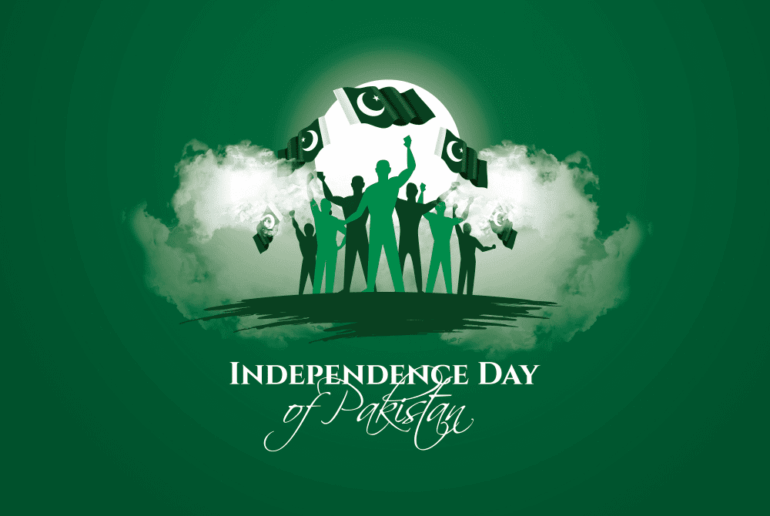
Independence Day of Pakistan, celebrated on August 14 each year, is a national holiday that holds great significance for the country. On this day in 1947, Pakistan emerged as an independent nation, freed from British colonial rule. The day serves not only as a reminder of the struggles and sacrifices made for freedom but also as an opportunity to unite the people in celebration of their national identity. Across the country, government offices, educational institutions, markets, and other organizations are closed to mark this historic occasion. It is a day to reflect on Pakistan’s journey, honour its history, and embrace the spirit of patriotism and national pride.
Background
The Indo-Pak subcontinent was under British colonial rule from 1849 to 1947. During this period, the people of the subcontinent increasingly opposed British control. One of the first significant uprisings against British rule was the Indian Rebellion of 1857, which, though unsuccessful, marked the beginning of a widespread freedom movement. This uprising, also known as the First War of Indian Independence, became a symbol of resistance and inspired future generations in their struggle for independence.
Before British colonization, the subcontinent was largely governed by Muslim rulers. However, the British East India Company’s takeover, particularly following the 1857 uprising, significantly altered the political landscape. Key Muslim leaders such as Sir Syed Ahmed Khan and Syed Ameer Ali worked tirelessly to advocate for the political and social rights of Muslims, promoting education and political participation as vital tools for Muslim advancement in the face of British domination.
The Indian National Congress (INC) was founded in 1885 with the aim of securing more political rights for Indians under British rule. Over time, the INC grew to become the largest political party in British India. Several prominent Muslim leaders, including Muhammad Ali Jinnah, were initially part of the Congress and worked toward Hindu-Muslim unity as well as India’s independence from British rule.
However, the increasing polarization between Hindus and Muslims led to the formation of the All India Muslim League in 1906, which advocated for the rights of Muslims and their political representation. As demand for a separate Muslim state in India grew, Muhammad Iqbal, in 1930, first proposed the idea of an independent Muslim-majority state. The term “Pakistan”, coined by Choudhary Rahmat Ali, is derived from two words: Pak (pure) and Stan (land), signifying the “Land of the Pure”.
The rise of Hindu nationalism during this period further intensified the demand for a distinct Muslim identity. In 1940, the Lahore Resolution, also known as the Pakistan Resolution, was passed by the Muslim League, formally calling for a separate Muslim state. The resolution was a direct response to the growing concerns over the political and cultural marginalization of Muslims in a post-colonial India.
Following the end of World War II and the weakening of British imperial power, it became clear that the British colonies would soon gain independence. The Pakistan Movement, led by Muhammad Ali Jinnah, ultimately succeeded in securing a separate Muslim-majority state. On August 14, 1947, Pakistan officially gained independence from British rule. Initially, Pakistan was divided into two regions – East and West Pakistan – separated by more than 1,600 kilometres of Indian territory. In 1971, East Pakistan seceded to form Bangladesh.
How People Celebrate Independence Day in Pakistan?
On Pakistan Independence Day, the entire nation comes together to celebrate with immense pride and reflect on the sacrifices made for the country’s freedom. The day begins with a formal flag-hoisting ceremony, which is typically held at key government buildings, with the most prominent event taking place at the Pakistan Monument in Islamabad. The national flag is raised accompanied by the patriotic strains of the national anthem, followed by a moment of silence to honour those who fought and sacrificed their lives for Pakistan’s independence.
Across the country, government buildings, including the Parliament House, Supreme Court, President House and Prime Minister’s Secretariat are beautifully decorated and illuminated with lights, creating a festive atmosphere. On the eve of Pakistan’s Independence Day, Minar-e-Pakistan in Lahore, the site where the Pakistan Resolution was passed in 1940, which called on for the creation of an independent state for Muslims, is illuminated to commemorate its significance in the country’s creation.
Both the Prime Minister and the President address the nation, offering congratulations and reflecting on the significance of the day. These speeches often emphasize the values of unity, patriotism, and the ongoing journey toward progress for the nation. A notable tradition is the ceremonial change of guard at national monuments, including the mausoleums of key figures such as Muhammad Ali Jinnah – widely regarded as the founder of Pakistan – and Muhammad Iqbal, the visionary poet, philosopher, and politician who first proposed the idea of an independent Muslim state.
In major cities like Karachi, Lahore, and Rawalpindi, the streets come alive with displays of national pride. Buildings are draped in green and white, the colours of the national flag, while portraits of Pakistan’s founding fathers and other national heroes can be seen everywhere. Citizens also don the national colours, with many dressing in traditional attire, including the iconic green and white garments, to express their patriotic spirit. This vibrant display of unity and pride reinforces the nation’s commitment to its shared history and values.
Parades, processions, and cultural events are a common feature of the celebrations. These events showcase Pakistan’s rich cultural diversity, highlighting its art, music, dance, and traditions. In cities large and small, fireworks light up the evening skies, creating a dazzling spectacle. Music festivals and concerts are held to celebrate Pakistan’s artistic contributions, with performances ranging from classical music to contemporary pop.
Television and radio stations air special programs that reflect on Pakistan’s history, its achievements since independence, and the ongoing efforts to build a prosperous future. These broadcasts serve not only as entertainment but also as an important reminder of the sacrifices made by past generations and the responsibility of the current one to continue the journey toward progress.
One of the most touching traditions on Independence Day is the public display of patriotism and remembrance. Citizens often visit the graves of national leaders, martyrs, and freedom fighters, paying their respects to those who contributed to the country’s liberation. These visits serve as a poignant reminder of the cost of freedom and the importance of preserving the country’s independence.
Families also take the opportunity to gather and celebrate together. The day is filled with traditional foods, laughter, and stories of Pakistan’s history, passed down through generations. Sharing these moments of joy and reflection strengthens the bond between citizens and reaffirms the importance of national unity.
In schools, the celebrations are especially meaningful for young Pakistanis. Students participate in a variety of activities, from singing patriotic songs to performing skits and speeches about the importance of Independence Day. These activities not only foster a sense of national pride but also educate the next generation about the struggles and triumphs that led to the creation of Pakistan. It is a day for both celebration and reflection, reminding everyone that the journey toward a better future is ongoing and requires continuous effort and dedication.
The Spirit of Independence Day beyond Pakistan’s Borders
While Pakistan’s Independence Day is celebrated with immense pride and joy within the country, the spirit of this historic day extends far beyond its borders, reaching Pakistani communities across the globe. Flag-raising ceremonies are held at Pakistani diplomatic missions in various countries, bringing together Pakistanis living abroad to honour their homeland’s hard-earned freedom. These events not only serve as a reminder of Pakistan’s founding but also highlight the ongoing connection between the diaspora and the nation.
In cities around the world, where large Pakistani communities reside, such as Riyadh, London, Dubai, New York, Chicago, Toronto, Rome, Berlin, Madrid or Paris, the sense of patriotism on this day is palpable. At all diplomatic missions, the flag of Pakistan is raised with the same dignity and reverence as it is in Islamabad, while the national anthem is played, evoking a deep sense of national pride among the expatriates. For many Pakistanis living far from home, Independence Day becomes an opportunity to reaffirm their bond with Pakistan, no matter how many miles separate them.
The celebrations at embassies and consulates often include speeches by Pakistani diplomats and local political leaders, who address the significance of the day and encourage the diaspora to continue supporting Pakistan’s development and growth. These events are not only about remembering the past but also about inspiring the future generation of Pakistanis living abroad to contribute to the progress of both their adopted countries and Pakistan itself.
Moreover, the celebrations are a chance for Pakistanis abroad to share their culture, traditions, and values with the wider international community. Many diplomatic missions organize cultural performances, food festivals, and exhibitions that showcase Pakistan’s rich heritage, from traditional music and dance to displays of regional art and crafts. These events help create a bridge between Pakistan and the host countries, fostering a sense of pride among the diaspora while also educating others about the country’s history and culture.
For expatriates, especially those who may not be able to return to Pakistan for the day, these ceremonies provide a vital link to their roots. The sense of collective pride and unity felt at these events can be deeply emotional, as they reflect on the sacrifices made by past generations to secure the independence they now celebrate. It is a day for Pakistanis around the world to not only celebrate their freedom but also to reflect on the ongoing journey of their nation, to honour its founding principles, and to express their shared hopes for its future.