
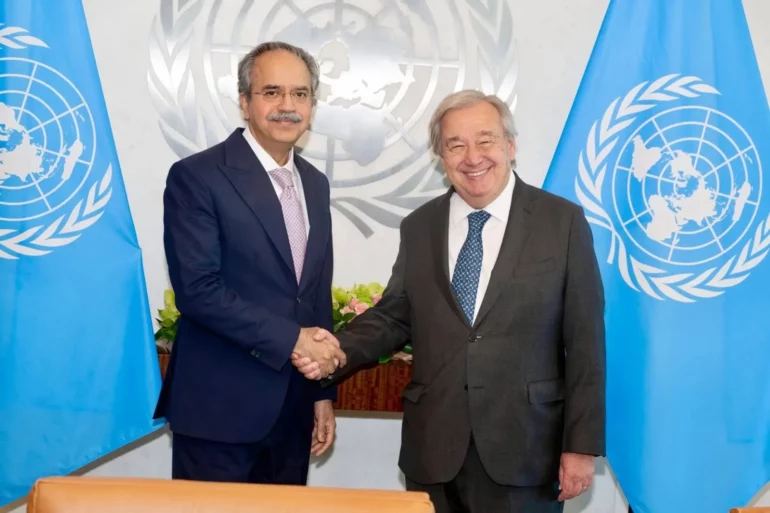
On July 1, 2025, Pakistan assumed the rotating presidency of the United Nations Security Council (UNSC) for the month of July, as part of its two-year term as a non-permanent member, which began in January 2025. This comes at a time of significant geopolitical challenges, with international security concerns, regional conflicts, and shifting alliances demanding decisive action and effective diplomacy. Under Pakistan’s presidency, the Security Council will be tasked with addressing these pressing issues while shaping policies that promote global peace and stability.
A Legacy of Diplomacy and Commitment to Global Peace
Pakistan officially became a member of the United Nations on 30 September 1947, just weeks after gaining independence. From the outset, the country committed itself to the principles of peace, justice, and cooperation that underpin the UN’s mandate. Over the years, Pakistan has emerged as a staunch advocate for multilateral diplomacy, prioritizing the resolution of global conflicts through peaceful means and the promotion of human rights and international law.
On June 4, 2024, Pakistan was elected for the eighth time as a non-permanent member of the UNSC for the 2025-2026 term. Pakistan’s earlier terms on the Council were in 2012-13, 2003-04, 1993-94, 1983-84, 1976- 77, 1968-69 and 1952-53. This recurring election reflects global recognition of Pakistan’s commitment to global peace, its active contributions to peacekeeping missions, and its ability to manage complex international negotiations. The presidency of the UNSC rotates monthly among its 15 members, providing each with an equal opportunity to steer the Council’s agenda and proceedings.
An Agenda Focused on Peace, Dialogue, and Reform
Pakistan has planned two major signature events during its presidency. The first is a high-level open debate on „Promoting international peace and security through multilateralism and the peaceful settlement of disputes”. The meeting will be chaired by Pakistan’s Deputy Prime Minister and Minister for Foreign Affairs, Mohammad Ishaq Dar, with UN Secretary-General António Guterres expected to provide a briefing. Pakistan aims to produce a resolution as a key outcome of this discussion.
The second signature event will focus on „Cooperation between the United Nations and regional and subregional organizations in maintaining international peace and security”, with a particular emphasis on the Organisation of Islamic Cooperation (OIC). This session will also be chaired by Mohammad Ishaq Dar, and the OIC Secretary-General, Hissein Brahim Taha, along with a representative from the UN Department of Political and Peacebuilding Affairs (DPPA), are anticipated to brief the Council. A presidential statement may result from this meeting.
Additionally, Pakistan intends to convene a briefing on UN peace operations, with a senior UN official expected to provide an update.
The Security Council will also hold its quarterly open debate on „The situation in the Middle East, including the Palestinian question”. Additional meetings may be scheduled depending on developments in Israel and Gaza.
Key Middle Eastern issues on the agenda for July include:
- Syria: A monthly meeting addressing political and humanitarian tracks.
- Yemen: A monthly meeting on developments and the renewal of the mandate for the UN Mission to Support the Hodeidah Agreement (UNMHA).
- Lebanon: Consultations on the Secretary-General’s report regarding the implementation of Resolution 1701 (which calls for a cessation of hostilities between Israel and Hezbollah).
In Africa, the July program will address the following topics:
- Central African Republic (CAR): A review of the sanctions regime and the mandate of the Panel of Experts assisting the 2127 CAR Sanctions Committee.
- Sudan: A semi-annual briefing from the International Criminal Court (ICC) on its activities related to Darfur.
- West Africa and the Sahel: An informal interactive dialogue (IID) focused on enhancing counter-terrorism cooperation in the region.
Regarding European issues, Council members are expected to hold consultations on the UN Peacekeeping Force in Cyprus (UNFYCIP).
In Asia, the sole anticipated issue for July is the biannual consultations on the UN Regional Centre for Preventive Diplomacy for Central Asia (UNRCCA).
The Security Council will also hold its quarterly meeting on Colombia. A meeting on the situation in Haiti is also expected, alongside a renewal of the mandate for the UN Integrated Office in Haiti (BINUH).
Finally, other issues, such as Iran and Ukraine, may be raised depending on developments in July 2025.
Contributions to Global Peacekeeping
One of Pakistan’s most significant contributions to the UN is its role in peacekeeping. Pakistan has served in 46 United Nations peacekeeping missions in 29 countries around the world. The Pakistan Armed Forces are the fifth largest contributor of troops towards UN peacekeeping system, behind India and Rwanda. Since 1960, Pakistan has been a steadfast contributor to UN peacekeeping missions. It has so far sent more than 200,000 troops to the UN peacekeeping missions across the world. From the Congo to Haiti, from Bosnia to Liberia, Pakistani personnel have been praised for their professionalism, discipline, and unwavering commitment to peace. Over 170 Pakistani peacekeepers have sacrificed their lives in the line of duty, underscoring the country’s dedication to maintaining peace in conflict-ridden regions.
Advocating for Justice and Equity
Pakistan’s geographic location and historical ties to both the East and West position it as a unique mediator in global conflicts. It has played a central role in peace initiatives in Afghanistan, served as a mediator in high-stakes talks between Iran and Saudi Arabia, and maintained diplomatic ties with major powers like the United States, China, and Russia. This ability to engage across different divides – both ideologically and geopolitically – makes Pakistan a valuable player in the international arena, especially in today’s fragmented world.
Pakistan has also been a vocal advocate for the rights of marginalized communities in the UN, particularly the Palestinians and the people of Kashmir. Its diplomacy has consistently focused on promoting peaceful conflict resolution, respecting international law, and advancing the cause of self-determination. As an active member of the Group of 77 (G77) and the Non-Aligned Movement (NAM), Pakistan has sought to foster a more equitable global order – one that addresses the economic disparities between the Global South and the developed world.
Why Pakistan’s Presidency Matters
Though the presidency of the UNSC is largely a procedural role, the country holding this position has the power to set the agenda, facilitate discussions, and shape the Council’s responses to emerging crises. As a non-permanent member, Pakistan will not have veto power. This means that it will not be able to veto any decision or block resolutions.
Pakistan’s presidency in July 2025 comes at a crucial moment when the world is facing numerous challenges, including:
- Humanitarian crises in Gaza, Sudan, Ukraine, Syria, Democratic Republic of the Congo, Afghanistan, Yemen, Ethiopia and Chad.
- The Gaza war.
- Rising geopolitical tensions, especially among major powers in the Indo-Pacific region.
- An escalating threat of global terrorism and cyber-attacks.
- The growing impact of climate change and related security risks.
- A need to reform the UNSC.
Pakistan’s presidency offers an opportunity for a measured, diplomatic approach that emphasizes dialogue over division, cooperation over conflict. With its neutral stance and strong diplomatic relationships with both the East and West, Pakistan is uniquely positioned to facilitate conversations that could help de-escalate tensions and build consensus on global security matters.
Pakistan’s assumption of the UNSC presidency is a moment of pride not only for the nation but also for all those who believe in multilateralism and diplomatic solutions to global problems. It serves as a reminder that despite the turbulence of our times, the values of dialogue, cooperation, and mutual respect remain central to the pursuit of lasting peace.
Photo: Ambassador Asim Iftikhar Ahmad, Permanent Representative of Pakistan to the United Nations and the United Nations Secretary-General António Guterres © The United Nations