
LTG Link, the passenger transport division of the Lithuanian state-owned railway company, LTG Group, signed a EUR 226.5 million contract for 15 new electric and battery-operated trains manufactured in Poland by Stadler Polska, a subsidiary of Swiss train maker Stadler Rail. The trains will be customized to fit the country’s broad-gauge railway system, making them 60 cm wider than standard models.
9 electric and 6 battery-powered trains are expected to serve key routes, including Vilnius–Klaipėda, Vilnius–Varėna–Marcinkonys, and Kaunas–Šiauliai. The battery-powered units are intended primarily for regional lines with low passenger volumes, where full railway electrification is not foreseen in the near future. These trains will operate in hybrid mode – drawing power from overhead lines where available and switching to battery power on non-electrified segments.
Production in Poland
The new trains are being assembled at Stadler’s modern facility in Siedlce, eastern Poland. Stadler Polska, a subsidiary of the Swiss group Stadler Rail, began operating in Poland in 2006 and currently employs over 1,000 people. It has six assembly workshops, covering a total area of more than 25 thousand sq. m as well as an innovative, robotic warehouse, which ensures smooth supply to production.
Greener, Smarter, More Comfortable
The new fleet is a major step toward sustainable mobility. Powered by renewable electricity, the electric and battery-operated trains will produce near-zero CO₂ emissions. Battery units will be used on routes that lack full electrification, with a range of up to 120 kilometres without overhead lines.
Electric trains for the Vilnius–Šiauliai–Klaipėda route will be equipped with about 200 comfortable seats, i.e. 30% more than current trains. During peak hours, up to three units can be connected to carry as many as 600 passengers. The trains are designed with low-floor entrances and barrier-free interiors, making them easily accessible for seniors, parents with strollers, and people with reduced mobility.
Designed for Every Passenger
Passenger comfort and accessibility have been prioritized. The trains will feature universal design principles, with wide aisles, step-free carriages, and dedicated areas for passengers using wheelchairs, including accessible tables and seats for accompanying persons. Up to 30 bicycles can be accommodated during the summer season, with convertible seating arrangements available in colder months.
In addition to first- and second-class compartments, passengers will find stroller spaces, pet areas, and a bistro section or snack vending machines for food and drinks.
On Track for 2026
Production is already halfway complete for the first three units – two electric and one battery-powered – and testing in Lithuania is scheduled to begin in autumn 2025. The new trains are expected to enter service by mid-2026.
LTG Link currently operates a fleet of 50 passenger trains and transports around 5.5 million passengers annually. With the new additions, the group aims to nearly double that figure to 10 million by 2030.
Conclusion
By investing in modern trains from Stadler, Lithuania is taking a significant step toward a more sustainable, accessible, and comfortable public transport system. The new units will not only boost passenger capacity and enhance travel quality but also contribute to reducing emissions and improving the integration of regions with major cities. These new trains represent Lithuania’s broader commitment to modern mobility and greener public transport for the decades ahead.
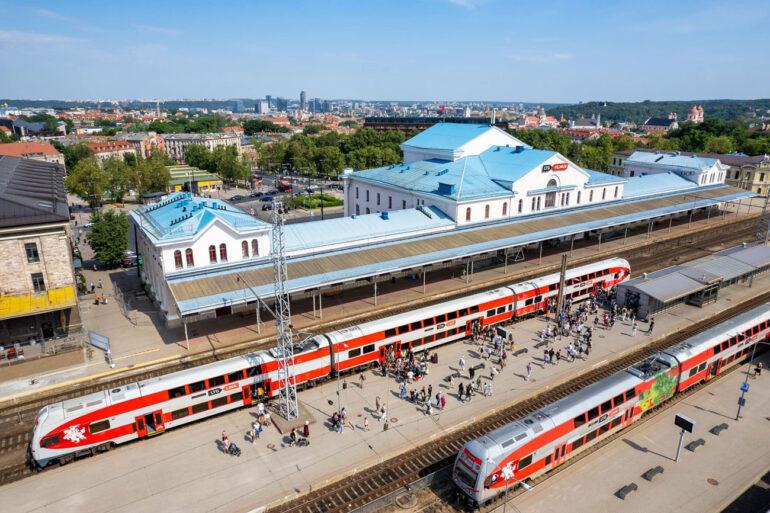
Photo: Vilnius Central Railway Station © LTG Link photo