
Poland reinstated controls on borders with Germany and Lithuania at midnight between 6 and 7 July in response to fears of increased irregular crossing by migrants. The controls were introduced to combat illegal migration, crime, and human trafficking.
According to the draft regulation published on Wednesday, border checks are set to be reintroduced for 30 days, from July 7 to August 5, but could be extended.
On the Polish-German border, checkpoints were established at 52 places: 41 road crossings, including for pedestrians and cyclists; eight railways crossings; and three river crossings. On the Polish-Lithuanian border, 13 control sites (one rail and 12 road) have been set up.
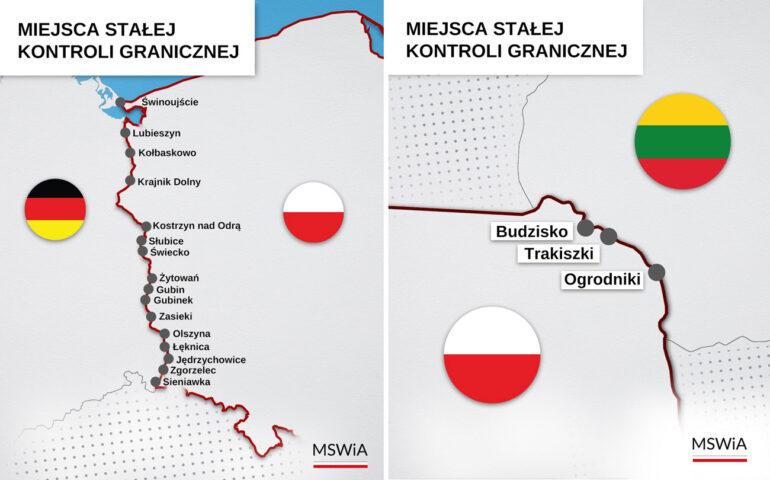
16 of the crossing points with Germany and 3 with Lithuania (Ogrodniki, Budzisko, Trakiszki) have been designated as places where constant checks will take place, with border guard officers permanently present. The Lithuanian border is used by migrants who irregularly enter Latvia and Lithuania from Belarus before heading westwards through Poland.
Prime Minister Donald Tusk announced the border controls last week in response to growing domestic pressure, in particular over Germany’s policy of returning to Poland hundreds of migrants each month who crossed the border unlawfully.
In June and July, self-declared ‘citizen patrols’ have been formed on the Polish side of the German border, seeking to monitor and prevent returns of migrants from Germany.
The Polish interior ministry said that only selected individuals and vehicles entering Poland would be checked, without unnecessarily disrupting border traffic. In particular, vehicles with large numbers of passengers and those with tinted windows are likely to be stopped.
The interior ministry revealed that 800 border guard officers would be working at the new checkpoints, supported by 500 territorial soldiers, 300 police officers and 200 military police.
The European Union has a visa-free travel area, known as Schengen, that allows citizens of most member states to travel easily across borders for work and pleasure.
According to the EU, member states are allowed to temporarily reintroduce border controls in cases of a serious threat, like internal security. It says border controls should be applied as a last resort in exceptional situations, and must be limited in time.
Photo: Permanent checkpoints established by Poland on the Polish-German and Polish-Lithuanian borders © Ministry of the Interior and Administration (MSWiA)